
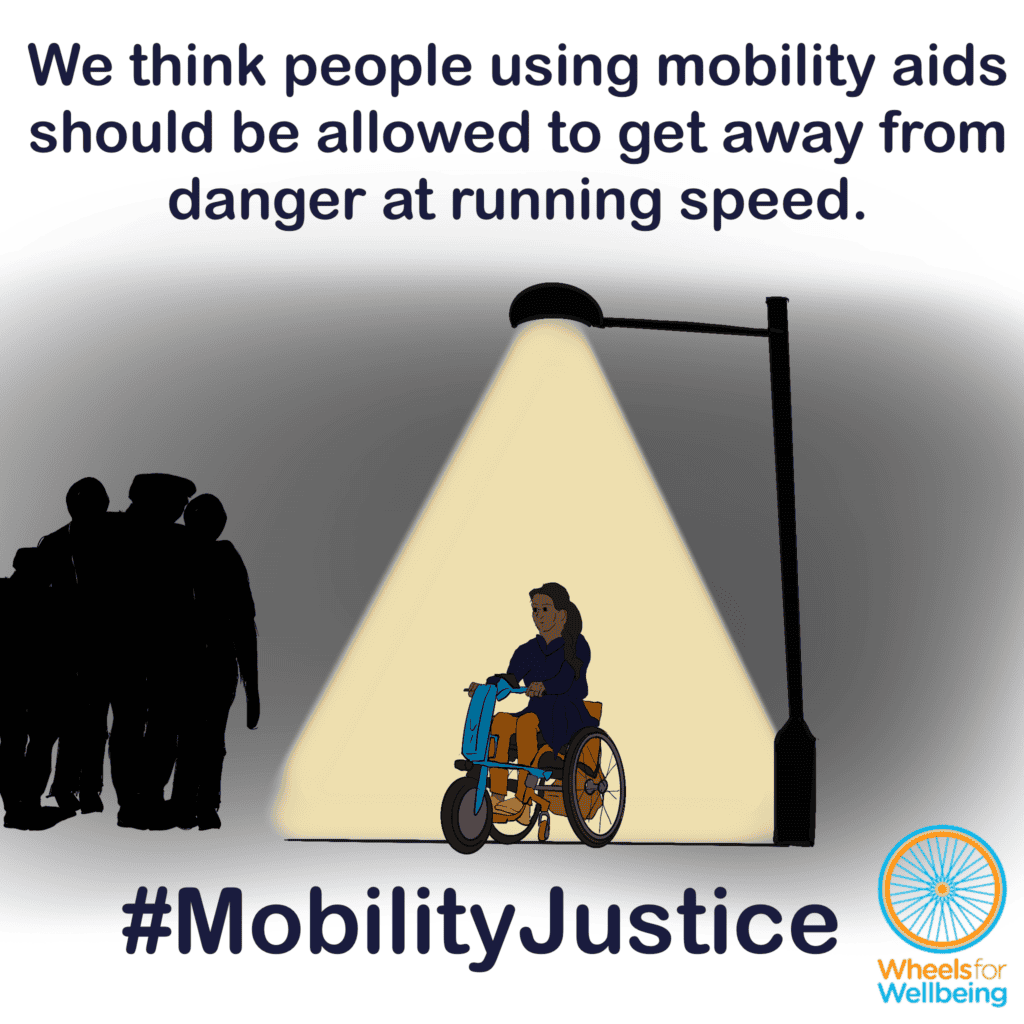
Why can’t people using mobility aids already get away from danger at running speed?
In the UK at present, laws about “invalid carriages” largely determine what mobility aids Disabled people can use.
The law says that powered “invalid carriages” may only be used at a maximum powered speed of 4mph everywhere except for on roads, where class 3 devices may go at up to
8mph.[1] Powered wheelchairs and mobility scooters used by children under 14 are only allowed to be class 2, with maximum speed 4mph. Many NHS services will only provide people of any age with class 2 wheelchairs or class 3 chairs with a maximum speed of 4mph, and with extremely restrictive provision criteria that exclude many people who need powered wheelchairs or power assistance from all wheelchair provision.[2]
Speeds in context:
1mph: People using manual wheelchairs typically move at less than 1mph without assistance from a walking person or power attachment. Even fit people using manual wheelchairs will rarely be able to sustain speeds of 4mph for longer distances on typical pavements and streetscapes, except for on very good quality surfaces and/or downhill.[3]
4mph is the maximum permitted speed for class 2 “invalid carriages”. 4mph is a brisk walking speed.[4] No powered mobility aids are allowed to go faster than 4mph, except on roads.[5]
8mph is the maximum permitted speed for class 3 “invalid carriages”. 8mph is a brisk jogging speed.[6] No powered mobility aids that are allowed to go on pavements can be capable of going at above 8mph, even if the person using them slows to 4mph on pavements as is required.
12.4mph (20kph), is the current maximum speed that fully-powered mobility aids can be safety certified under existing British Standards for powered wheelchairs and mobility aids. 12.4mph is a moderate cycling speed or fast long-distance (5km+) running speed.[7]
15.5mph (25kph) is the maximum permitted powered speed for legal e-cycles (EAPCs) and the maximum permitted speed for trial scheme e-scooters. Like “invalid carriages”, e-cycles currently may be used by anyone aged over 14, with no requirements for a driving licence, registration or insurance.[8]
Why aren’t slower maximum speeds always safer?
For all mobility devices, we’re talking about relatively low maximum speeds: Even when we’re talking about going fast using mobility devices, we’re asking for absolute maximum powered speeds of 15.5mph, which would be a fast sprint or decent unpowered cycling speed on level ground for most non-disabled people.
When we’re talking about these relatively low speeds, we think sometimes it’s safer to go slower, and sometimes it’s safer to go faster. There are also reasons other than safety for choosing to go more slowly or more quickly which apply to all Disabled and non-disabled people, for example the need to complete journeys in a timely fashion, keeping up with companions, or simply for the joy and exhilaration of moving outdoors. Within the tight maximum speed limits we’re advocating, we need to leave it to individuals to judge which speeds are most appropriate at any particular moment. Assessing risks and benefits will be discussed further in our upcoming “Risks and Benefits” explainer sheet.
Having a maximum speed that’s too slow will prevent some Disabled people from using mobility devices at all. Some people will drive more journeys. Lack of adequate mobility aid function will prevent other people from making necessary trips. Increased driving and decreased mobility both cause safety hazards directly to Disabled individuals and to other people in public spaces. This is discussed further in our “Similar Trips, Similar Speeds” explainer sheet.[9]
Getting away from danger – isolated or constrained spaces
Being able to increase speed to get away from perceived risks is important for Disabled people’s safety when making typical journeys. This is equivalent to a non-disabled person stepping up their pace or breaking into a run when they feel a location is unsafe. Disabled people and especially Disabled people with multiple protected characteristics are at greater risk of harm from harassment and assaults in public spaces than non-disabled people.[10] [11] Inability to escape at running-equivalent speeds may well be a factor contributing to this increased risk.
The need to speed up to get away from danger applies both when we’re travelling as pedestrians and when using cycling-equivalent mobility options. Disabled people need the option to use our judgement to keep ourselves safe when making trips on all pedestrian and cycle-permitted spaces, including on all footpaths, cycle routes, towpaths, alleyways, parks and streets, at all times of day or night.
Getting away from danger – avoiding collisions with drivers
Whether we’re using a powered mobility device to ride down a road, or we’re using a road crossing, being unable to speed up to get out of danger can put us at risk. Disabled people are at much greater risk than non-disabled pedestrians of being injured or killed in collisions with vehicles.[12] Being unable to move fast enough out of the path of an oncoming vehicle may well be a factor in this increased risk.
Disabled people using mobility aids typically have lower head heights than average height walking adults. Pedestrians, cyclists and drivers including autonomous vehicle control systems may all be less likely to notice people with lower head heights, especially if we also have less common shapes or silhouettes, and especially if we move in less expected ways: for example, if we move slowly or erratically, picking our way over an uneven surface and around potholes, or while supporting another person.
Being able to increase speed in a way equivalent to a non-disabled person running or leaping out of the way of an oncoming vehicle is important for Disabled people’s safety when making typical journeys.
The need to speed up to get out of danger applies both when we’re travelling as pedestrians and when using cycling-equivalent mobility options. Disabled people need the option to use our judgement to keep ourselves safe when making trips on typical urban, suburban, peri-urban and rural streetscapes and roads.
Staying safe – device specifications including speed restrictions for individuals
Some people need or want to have mobility devices that have lower maximum speeds. That might be because the device type they choose isn’t tested for safe functioning at higher speeds, or because their own capacity means they aren’t able or don’t feel able to control a device safely at higher speeds. Children below age 16 and adults appropriately assessed as lacking mental capacity to make decisions about their mobility must be helped to make reasonable decisions about their mobility devices by appropriately designated supporters. For more information about mental capacity, see the Wheels for Wellbeing mental capacity explainer.[13]
Decisions about restricting a device speed to below the legal maximum or the device’s safe maximum functioning speed (whichever is lower) should always be taken by an individual and/or their appropriately designated supporters.
Decisions about additional technology should equally be taken by an individual and/or their designated supporters. Additional technologies that will benefit some mobility device users include options such as collision and hazard avoidance systems, line following, autonomous driving, and geofencing.
What legal changes do we need?
A small number of legal changes would make big differences to different accessible mobility options for a lot of different people. You may notice that this legal changes section is the same or similar in some of the other case studies in this series!
We want new mobility aid laws to be fit for purpose, fair and future-proofed.
- Mobility devices should have maximum permitted powered speeds for public space use aligned with e-cycles (or micromobility like e-scooters). That’s presently 15.5mph.
- Disabled people of all ages should have the right to use our chosen mobility devices (within specified dimensions and function categories[14]) at pedestrian speeds everywhere pedestrians have the right to go.
- Disabled people of all ages should have the right to use our chosen mobility devices at cycling or cycling-equivalent speeds in all cycling-permitted spaces.
- Regulations prohibiting and enforcement against dangerous and antisocial behaviour by all public space users apply equally to all mobility aid users.
This isn’t radical – we just want Disabled people using mobility aids to have equal access to pedestrian, cycling and cycling-equivalent journey-making options that non-disabled people already enjoy!
- The Equality Act (2010) requires the government to make all reasonable adjustments to regulations to provide Disabled people with mobility equality[15] – and says these adjustments must be made before any Disabled people experience discrimination.
- The Mental Capacity Act (2005) says that everyone must be assumed to have the capacity to make reasonable decisions.[16] That means it’s not reasonable to apply blanket low maximum speeds and use restrictions to mobility aids meant for Disabled people that don’t apply to comparable devices like cycles, e-cycles and e-scooters that are mostly intended for use by non-disabled people.
- Some Disabled people already use a full range of e-assist cycles and trial scheme e-scooters at up to 15.5mph powered speeds in all cycle-permitted spaces.
- Some Disabled people already use fully powered mobility aids that are certified under existing British Standards for wheelchairs and mobility scooters for safe use up to 12.4mph.
- Disabled people already use our judgement to select appropriate speeds for different spaces, just as other pedestrians do. For example, we typically slow to well below 4mph in busy and constrained spaces such as narrow pavements, shopping centres and transport hubs, where safe speeds are likely to be no more than 1-2mph.
What you can do
We want Disabled people to have the same journey-making choices as non-disabled people. For this to happen, we need the law to change. The Department for Transport is running a consultation into changing mobility aid laws. The consultation deadline is 22nd April 2026.
You can help make changes to improve mobility options for all Disabled people:
- Read our explainers and recommendations. We are concerned about some of the consultation wording and a lack of information on current laws in the consultation document. Without our extra information, case studies and links to other sources, we’re worried people could accidentally give answers that will cause problems for themselves or others.
- Once you’ve read and considered our explainers and recommendations, please respond to the Department for Transport’s consultation.
The information in this sheet directly links to consultation questions 20, 21 and 22, and indirectly to a range of other questions, including 10-13.
We are releasing free resources about all areas of mobility aid regulations to cover all aspects of the consultation as quickly as we can. Resources include written information, case studies, graphics, social media and webinars.
Follow all our information updates and find out more about how changes to the law can improve mobility for Disabled people on Bluesky, LinkedIn, Instagram and Facebook.
Contact us with comments, questions and suggestions at info@wheelsforwellbeing.org.
Join our free peer-support campaigning forum for Disabled people and allies.
Sign up for our newsletter (bottom of page)
[1] Chronically Sick and Disabled Persons Act (1970) s 20 https://www.legislation.gov.uk/ukpga/1970/44/section/20 and Use of Invalid Carriages on Highways Regulations (1988) https://www.legislation.gov.uk/uksi/1988/2268
[2] E.g. see NHS wheelchair services eligibility criteria, for example Bedfordshire and Luton https://www.elft.nhs.uk/sites/default/files/2022-08/Eligibility%20Criteria%20For%20Wheelchairs%20Final%20Agreed%20March%202020..pdf North West London 2025 https://www.nwlondonicb.nhs.uk/application/files/6517/3754/2011/NHS_North_West_London_Wheelchair_Service_Eligibility_Criteria_January_2025_22.01.25.pdf and Wirral https://www.wchc.nhs.uk/services/wheelchair/are-you-new-to-the-wheelchair-service/are-you-eligible-for-a-nhs-wheelchair/
[3] See this study in which participants were mainly wheelchair-using ex-service personnel and athletes: Sonenblum, SE, Sprigle, S and Lopez, RA (2012) “Manual Wheelchair Use: Bouts of Mobility in Everyday Life” Rehabilitation Research and Practice https://doi.org/10.1155/2012/753165
[4] Multiple sources, e.g. British Heart Foundation https://www.bhf.org.uk/how-you-can-help/events/walking-and-trekking-faqs
[5] For full references see Wheels for Wellbeing My Mobility Device information and sources Excel document: https://wheelsforwellbeing.org.uk/wp-content/uploads/2026/02/My-Mobility-device-information-and-sources-v06.xlsx
[6] Running constantly at 8mph would enable a runner to complete 10km in 47 minutes, or 5km in 23 minutes. This is a good amateur running time. The average Parkrun time in the UK (casual 5km fun run for all) is 29:30, with record men’s time 13:44 minutes and record women’s time 15:13 minutes https://therunningchannel.com/average-parkrun-time/
[7] Longer-distance runners (5km+) typically run at 4-9mph/7-15kph, with world record speeds of above 12mph/20kph. Sprinters are able to reach up to 10m/s, 22mph, over short distances. See:
Selinger, J et al (2022) “Running in the wild: energetics explain ecological running speeds” (author manuscript) https://doi.org/10.1016/j.cub.2022.03.076
Wikipedia 5k world record progression https://en.wikipedia.org/wiki/5K_run_world_record_progression
Wikipedia 100m world record progression https://en.wikipedia.org/wiki/Men%27s_100_metres_world_record_progression
[8] See full regulations details for e-cycles and other devices at Wheels for Wellbeing My Mobility Device information and sources spreadsheet: https://wheelsforwellbeing.org.uk/wp-content/uploads/2026/02/My-Mobility-device-information-and-sources-v06.xlsx
[9] Wheels for Wellbeing explainer – “Disabled people should be allowed to make similar trips at similar speeds to non-disabled people”: https://wheelsforwellbeing.org.uk/similar-trip-speed/
[10] Government Disability Unit. 2021. “UK Disability Survey research report, June 2021” https://www.gov.uk/government/publications/uk-disability-survey-research-report-june-2021/uk-disability-survey-research-report-june-2021
[11] Emerson, E, Krnjacki, L et al. 2016. “Perceptions of safety and exposure to violence in public places among working age adults with disabilities or long term health conditions in the UK: cross sectional study” Public Health vol 135 p 91-96. https://doi.org/10.1016/j.puhe.2015.10.036
[12] Aldred, R. 2018 Inequalities in self-report road injury risk in Britain: A new analysis of National Travel Survey data, focusing on pedestrian injuries.” Journal of Transport and Health vol 9 p 96-104. https://doi.org/10.1016/j.jth.2018.03.006
[13] Wheels for Wellbeing “All Disabled and non-disabled people must be presumed to have the capacity to make our own decisions” https://wheelsforwellbeing.org.uk/disabled-people-must-be-presumed-to-have-the-capacity-to-make-our-own-decisions/
[14] For more details see the Every Journey Everyone campaign page, including the Wheels for Wellbeing draft consultation response: https://wheelsforwellbeing.org.uk/wp-content/uploads/2026/02/2026-WfW-mobility-aids-consultation-model-answers-v02.docx
[15] Wheels for Wellbeing Quick Guide to the Equality Act 2010 https://wheelsforwellbeing.org.uk/wheels-for-wellbeing-quick-guide-to-the-equality-act-2010/
[16] Mental Capacity Act 2005 https://www.legislation.gov.uk/ukpga/2005/9/contents
Please donate to support our work if you can:
Wheels for Wellbeing is a small Disabled People’s Organisation – a charity run by and for Disabled people. We depend on donations for our campaigning work: very few grants are available for campaigning.
Any donation you can make helps us keep working to achieve mobility justice for all.
#MobilityJustice #EveryJourneyEveryone