
Aren’t the rules and regulations already clear?
In the UK at present, laws about “invalid carriages” largely determine the mobility aids Disabled people can use, but other laws and standards including about roads and vehicles, highways, and product standards also affect how mobility aids work and where different aids may be used.
The regulations and standards which affect mobility aids are in lots of different places. The rules themselves are poorly-understood, discriminatory and illogical. Government guidance is unclear and sometimes incorrect,[i] and standards for how mobility aids should work are hidden behind high paywalls.
The consequences to mobility device users of unclear, poorly-understood and hidden rules are serious:
1. Unclear and poorly-understood rules put mobility device users at risk
Disabled people using mobility aids sometimes break laws they don’t know exist, or when following rules would put them at risk or make mobility impossible – for example, rules against using mobility scooters in cycle lanes and bus lanes and impossible wheelchair weight limits for some children.
But if something goes wrong, a Disabled person who’s breaking the law is at risk of having their mobility aid confiscated [ii] or even of being prosecuted, even if what they were doing didn’t put anybody at risk or if they thought they were following the rules.
Finding out what the rules are is almost impossible: Guidance provided by the government [iii] and by mobility device suppliers [iv] is frequently wrong, leaving Disabled people unable to find out what we are and aren’t allowed to do, and, even more concerningly, leaving us at risk of incorrect enforcement and discrimination by officials who’ve learned wrong rules.
We know that some insurers are offering third party public liability insurance for wheelchair power attachments with top speeds above 8mph –though these devices are not legal for public spaces use (unless they are registered and insured as motor vehicles for on-road use only). We suspect that if an incident occurred, people who’ve been careful to insure themselves could find their policies are not valid.
2. Both “Grey areas” in rules and clear bans cause inaccessibility and discrimination
You can’t bring that in here!
Disabled people are being refused access to public transport, public services and maintenance support such as puncture repairs, with staff typically stating that they are afraid of potential consequences of allowing people using safe and legal devices to use their services. Public transport companies have only ever allowed a very limited range of mobility devices onto their services, and unclear regulations are making an already bad situation worse.
Without clear rules, challenging discrimination is made much more difficult. Disabled people are put at increased risk of harassment, abuse, and being unable to get to the places we need to go.
3. “Grey areas” in rules and clear bans stop new devices from being developed and sold
We’ve explained in other documents how tandem mobility scooters and aids or attachments comparable to prams and pushchairs are currently either not allowed to be used in public spaces, or at best exist in a very grey area of regulations – even when these devices are thoroughly safety tested and are legal in other places.
The laws against multi-person “invalid carriages” and against trailers on invalid carriages mean that there are no commercially-available products in the UK to allow mobility aid-using parents/carers to transport children. This leaves many Disabled parents/carers unable to leave home with their children without finding another adult to assist them. Tandem devices are especially important for older people, especially couples where both have mobility impairments and one can’t control an aid due to visual or cognitive impairments. But few are available because, again, they aren’t legal in public spaces. There are no devices which Disabled people can connect together to allow one person to support another on difficult sections of journeys, comparable to child cycle towbars.
4. Hidden product standards prevent Disabled people from finding out how their devices should perform – and prevent people challenging poor performance
Mobility aids sold by reputable retailers or provided by the NHS are typically certified to relevant British Standards. British Standards also apply to cycles and other powered devices such as e-scooters.
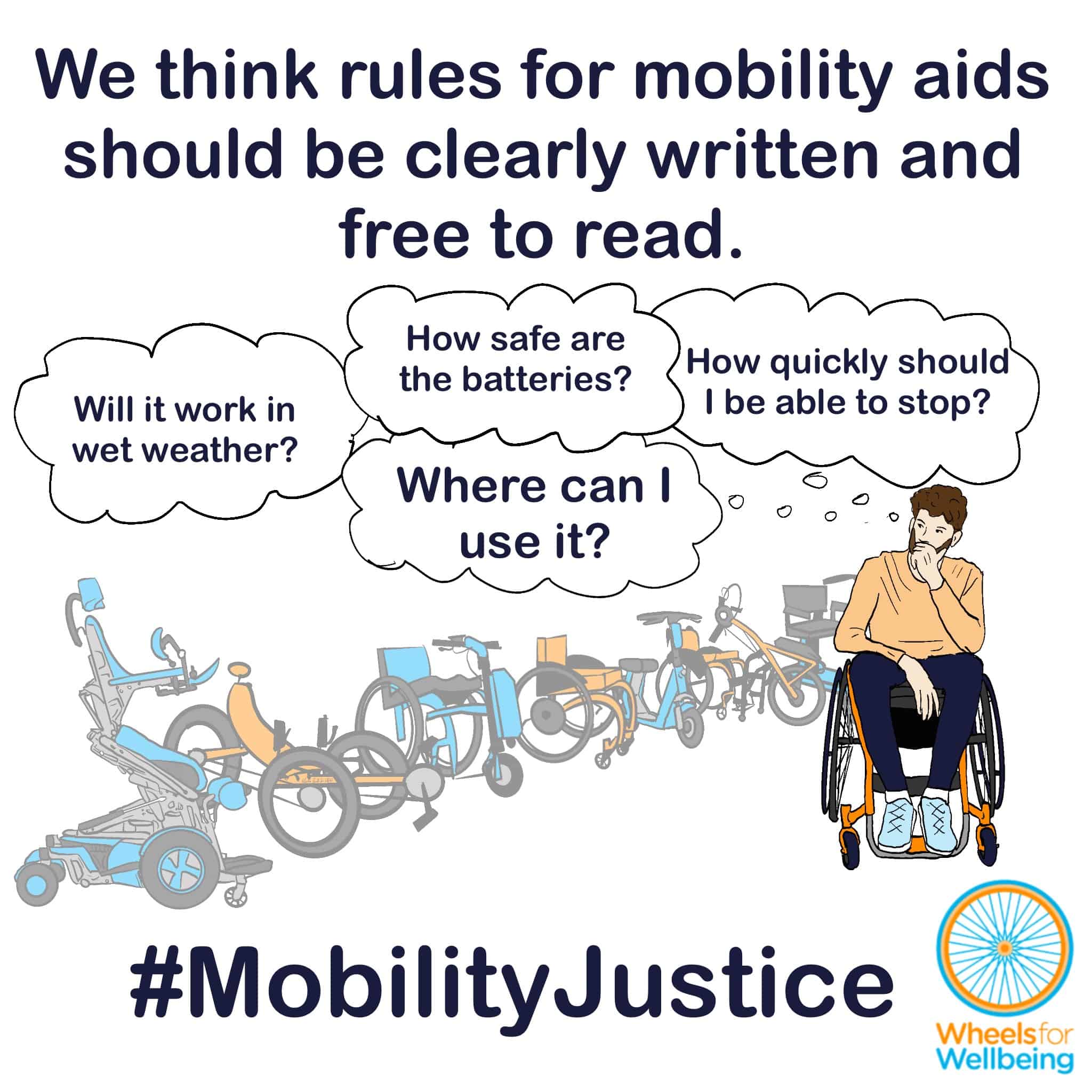
A certified aid must meet multiple standards – but the standards are each expensive to access. For example, the main British Standard for powered wheelchairs and mobility scooters is BS EN 12184:2022. This presently costs £488 on the BSI site.[v] We have found these standards are typically not available from library services. If you can access this standard, you’ll discover that you need to buy many more standards to find out how your device should actually work – such as whether you should be able to use it in rainy weather or go through puddles.[vi]
In fact: Current power wheelchair and mobility scooter standards only require devices to be tested in light showers of water. Unlike comparable e-cycles and e-scooters, let alone electric cars, manufacturers and suppliers of mobility aids typically advise that their British Standards-compliant powerchairs and mobility scooters shouldn’t be used in more than light rain, shouldn’t be driven through puddles, and should be dried carefully if they get wet.[vii]
We think that minimum requirements for basic functions like braking, lights, weatherproofing and stability should all be publicly available. Current e-scooter trial requirements for braking and stability provide a good example of how this can be done. [viii]
What legal changes do we need?
A small number of legal changes would make big differences to different accessible mobility options for a lot of different people. You may notice that this legal changes section is similar in some of the other case studies in this series!
We want new mobility aid laws to be fit for purpose, fair and future-proofed.
- Mobility aid regulations must articulate and facilitate Disabled people’s right to equal pedestrian, cycling and cycling-equivalent mobility, including
- explicitly providing the right to use a wide range of unpowered, e-assist and fully powered devices as mobility aids for pedestrian movement in pedestrian spaces.
- Explicitly providing the right for Disabled people to use a wide range of unpowered, e-assist and fully powered devices for cycling and cycling-equivalent movement in cycle-permitted spaces.
- Mobility aid regulations must be worded in plain English, with accessible and translated versions including BSL, Easy-Read, Welsh and other languages commonly spoken in the UK available alongside the primary version.
- If laws refer to other documents such as product standards, the other documents must be freely available, including in accessible formats.
- There must be a single, government-provided, accurate guidance document that explains all rules affecting the function and use of mobility aids that are legal to use in public spaces.
This isn’t radical – we just want all the rules for how mobility aids should work and how they must be used to be future-proofed, fair and written out clearly so everyone can read them for free!
- The Equality Act (2010) requires anticipatory reasonable adjustments to be made to provide Disabled people with equal access to non-disabled people, and requires public bodies to advance equality of opportunity for Disabled people. To meet the requirements of the Equality Act, mobility aid regulations must enable mobility equality and must themselves be accessible.[ix]
- The United Nations Convention on the Rights of Persons with Disabilities (UNCRPD) requires signatories, including the UK, to facilitate “the personal mobility of persons with disabilities in the manner and at the time of their choice, and at affordable cost”.[x]
What you can do
We want Disabled people to have the same journey-making choices as non-disabled people. For this to happen, we need the law to change. The Department for Transport is running a 15-week consultation into changing mobility aid laws. The consultation deadline is 22nd April.
You can help make changes to improve mobility options for all Disabled people:
- Read our explainers and recommendations. These should all be released by mid February 2026.We are concerned about some of the consultation wording and a lack of information on current laws in the consultation document. Without our extra information, case studies and links to other sources, we’re worried people could accidentally give answers that will cause problems for themselves or others.
- Once you’ve read and considered our explainers and recommendations, please respond to the Department for Transport’s consultation.
The information in this sheet directly links to consultation questions 20, 21 and 22, and indirectly to a range of other questions, including 10-13.
We are releasing free resources about all areas of mobility aid regulations to cover all aspects of the consultation as quickly as we can. Resources include written information, case studies, graphics, social media and webinars.
Follow all our information updates and find out more about how changes to the law can improve mobility for Disabled people on Bluesky, LinkedIn, Instagram and Facebook.
Contact us with comments, questions and suggestions at info@wheelsforwellbeing.org.
Join our free peer-support campaigning forum for Disabled people and allies.
Sign up for our newsletter (bottom of page)
References
[i] Government guidance on “using mobility scooters and powered wheelchairs” states that to drive on the road, devices must be in class 3 or “not in class”. There is also a section on “eyesight requirements” – but there are no eyesight requirements for using mobility aids including wheelchairs and mobility scooters: If there were, Blind and visually impaired people who need to use powered wheelchairs would be banned from all independent mobility. See our mobility aids guide sheet for more information. https://www.gov.uk/mobility-scooters-and-powered-wheelchairs-rules/driving-on-the-road
[ii] We supported Israel Vidal after his wheelchair was confiscated along with a power attachment, when he tipped over on his way to a bus stop at walking speed. The mobility aids he was using are safety tested to relevant standards. https://www.bbc.co.uk/news/articles/c5y7dpwle4yo
[iii] Government guidance on “using mobility scooters and powered wheelchairs” states that to drive on the road, devices must be in class 3 or “not in class”. We do not think this is correct. See our mobility aids guide sheet for more information. https://www.gov.uk/mobility-scooters-and-powered-wheelchairs-rules/driving-on-the-road
[iv] For example, John Preston “what are the laws on use of wheelchair power attachments” which heavily implies that wheelchair power attachments are class 1 “invalid carriages” that can’t be used on roads but may be used, including at high speeds, on pavements and in pedestrian spaces. It is our understanding that this is completely incorrect. https://www.johnpreston.co.uk/blog/post/what-are-the-laws-on-use-of-wheelchair-power-attachments
[v] BS EN 12184:2022 “Electrically powered wheelchairs, scooters and their chargers. Requirements and test methods” costs £488 on 26/01/2026 https://knowledge.bsigroup.com/products/electrically-powered-wheelchairs-scooters-and-their-chargers-requirements-and-test-methods
[vi] For example, ISO 7176 https://www.en-standard.eu/search/?q=7176
[vii] For example, this 2025 blog from Mobility Smart: https://www.mobilitysmart.co.uk/blog/can-i-use-my-mobility-scooter-in-the-rain-heres-what-the-law-and-science-says and this from Monarch Mobility: https://monarchmobility.com/blog/can-you-use-a-mobility-scooter-in-the-rain/?srsltid=AfmBOorJUojYc78AE3gd9eMHroHkCl7-NIMNQWJgRKvA_WEbPBpIO_El
[viii] Government e-scooter trials guidance for local areas and rental operators https://www.gov.uk/government/publications/e-scooter-trials-guidance-for-local-areas-and-rental-operators/e-scooter-trials-guidance-for-local-areas-and-rental-operators#minimum-technical-requirements-for-e-scooters
[ix] See Wheels for Wellbeing Guide to the Equality Act and Wheels for Wellbeing Guide to the Public Sector Equality Duty.
[x] United Nations Convention on the Rights of Persons with Disabilities article 20 – personal mobility https://www.un.org/development/desa/disabilities/convention-on-the-rights-of-persons-with-disabilities/article-20-personal-mobility.html
Please donate to support our work if you can
Wheels for Wellbeing is a small Disabled People’s Organisation – a charity run by and for Disabled people. We depend on donations for our campaigning work: very few grants are available for campaigning.
Any donation you can make helps us keep working to achieve mobility justice for all.
#MobilityJustice #EveryJourneyEveryone