
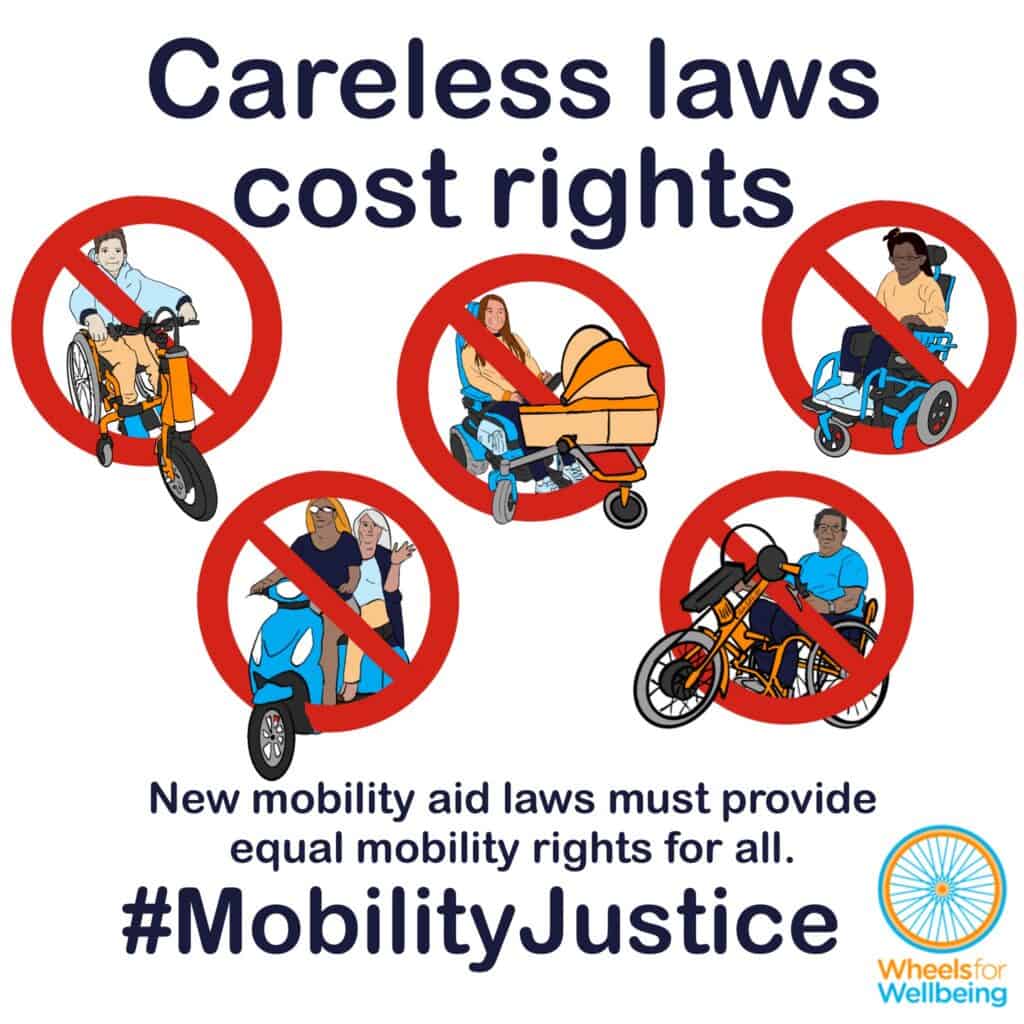
Key principles & requirements for mobility devices regulations[1]
- The Equality Act 2010[2] requires all anticipatory reasonable adjustments, to be made, including to regulations, to provide Disabled people with equal access.
- The Mental Capacity Act 2005[3] requires that all adults are presumed to have capacity to make decisions, except where an individual is assessed as not having capacity.
- Equal access rights: To meet the requirements of the Mental Capacity Act and Equality Act, mobility device regulations must provide equal rights to access pedestrian, cycling and cycling-equivalent mobility for Disabled people. This must include rights for:
- Disabled people to use diverse mobility aids at pedestrian speeds in all pedestrian spaces, and at cycling-equivalent speeds wherever cycling is permitted;[4] [5]
- Disabled people of all ages to use our chosen mobility aids to move in equivalent ways to non-disabled peers, including but not limited to:
- The right for Disabled people to transport others of all ages and cargo (e.g. shopping and luggage) in comparable ways to non-disabled people walking/cycling, e.g. using pushchairs, trailers, child seats/carriers and multi-person/separable aids;[6] [7]
- The right for Disabled children to use devices enabling movement at running and cycling-equivalent speeds, as their responsible adults deem appropriate.[8]
- Mobility device regulations must be least-restrictive, future-proofed and clearly worded. Regulations and associated standards must be freely available in accessible formats.[9] [10]
- Disabled people using mobility aids are subject to the same civil and criminal enforcement against dangerous and antisocial behaviour that apply to everyone.
The 2026 DfT Consultation on Powered Mobility Devices – concerns
Gunning Principle 2[11] requires that consultations provide “sufficient information to give ‘intelligent consideration’”. This is extended in Cabinet Office Consultation Principle C.[12]
Civil service questionnaire design guidance states “avoid leading questions” and “ask balanced questions”.[13]
This consultation does not provide adequate information to enable intelligent consideration or informed responses. It includes multiple leading and unbalanced questions. For example:
- Existing access rights are described inaccurately, including failure to provide full information on existing class 3 requirements and incorrectly implying class 1 and 2 device users do not have the same rights as other pedestrians to use carriageways.[14]
- Essential comparators including pedestrian and cycling speeds, permitted passenger numbers/ages, device dimensions/weights and existing access rights are not included.
- Multiple leading/unbalanced questions encourage respondents to support suggestions which would breach the Equality Act and Mental Capacity Act. E.g. “Minimum age of passengers” youngest response option is 1 year – without option to permit babies. Questions and info provided foreground only direct risks, not risk reductions and benefits.
Impact of present & potential regulations
We are receiving messages about impacts of mobility devices regulations from many Disabled people. Broad themes are below with a few examples from affected individuals:
- Transporting children: Disabled parents face isolation, legal and social care risks due to the current prohibition on multi-person aids and trailers, e.g.
M, a mobility scooter user banned by a court order from transporting their children on their mobility scooter during a custody battle – forcing them to choose between breaking the court order or being deemed an inadequate parent by the court for failing to get a child to school;
N, a wheelchair user, was required by social care to get written police permission to make local trips with their baby;
P, a mobility scooter user, is unable to buy a suitable device to transport their babies securely. They are now unable to make local trips and are severely isolated.
- Multi-adult aids: Disabled couples and families forced to keep driving, break the law or lose independence when family members need to support each others’ mobility, e.g.
David and Gill are risking legal action to stay safely mobile with their tandem mobility scooter – find our more about them and others like them in the blog they made with us.[15]
- Luggage and cargo: Disabled people face extra expense and barriers to basic activities including shopping, employment, education and leisure activities due to trailer ban, e.g.
R, a mobility scooter user, needs a trailer to be able to do their own food shopping.
- Speed restrictions: Disabled people need to make trips at similar speeds to non-disabled people, or face safety risks and exclusion, including from employment / healthcare, e.g.
Steph, a wheelchair user, explained in a blog how being able to make cycling-speed trips will now enable her to attend healthcare appointments without missing too many working hours.[16]
- Children’s mobility: Disabled children who need power or power-assist to move on unmade surfaces and/or at above walking speed are excluded from normal childhood activities by the present age and weight restrictions on mobility aids for under-14s, e.g.
B is prevented by current regulations from cycling to secondary school with friends. Read their case study in our explainer sheet on Disabled children’s mobility.[17]
- “Invalid carriages” regulations wider impacts: Disabled people using less widely recognised as mobility aid types are experiencing risks & access refusals affecting ability to use essential services, public transport, and to access education and employment, e.g.
C, a wheelchair and power attachment user, was banned from storing or charging their device in their accommodation, leading to physical injuries, isolation, and permanent damage to the power attachment battery through charging in cold conditions against manufacturer instructions. After multiple months of effort from C and following C taking legal advice, C’s accommodation provider took fire expert advice, which determined it is and always has been safe for C to charge their mobility aid in their accommodation.
References
[1] Wheels for Wellbeing Every Journey Everyone main resources page: https://wheelsforwellbeing.org.uk/our-campaigns/campaigning/mobility-aid-legal-changes-every-journey-everyone/
[2] Wheels for Wellbeing Quick Guide to the Equality Act 2010 https://wheelsforwellbeing.org.uk/wheels-for-wellbeing-quick-guide-to-the-equality-act-2010/
[3] Mental Capacity Act 2005 https://www.legislation.gov.uk/ukpga/2005/9/contents
[4] Wheels for Wellbeing resource – “Disabled people should be allowed to make similar trips at similar speeds to non-disabled people” https://wheelsforwellbeing.org.uk/similar-trip-speed/
[5] Wheels for Wellbeing resource – “Mobility aid users should be allowed to use cycle tracks, cycle lanes and bus lanes” https://wheelsforwellbeing.org.uk/mobility-aid-users-cycle-tracks/
[6] Wheels for Wellbeing resource – “People who use mobility scooters should be allowed to carry friends and family” https://wheelsforwellbeing.org.uk/we-think-people-who-use-mobility-scooters-should-be-allowed-to-carry-friends-and-family/
[7] Wheels for Wellbeing resource – “Parents who use wheelchairs should have the right to use prams and pushchairs” https://wheelsforwellbeing.org.uk/right-to-use-prams-pushchairs/
[8] Wheels for Wellbeing resource – “Disabled children should be allowed powered aids that let them run, cycle and explore with their friends” https://wheelsforwellbeing.org.uk/disabled-children-powered-aids/
[9] Wheels for Wellbeing resource – “We think rules for mobility aids should be clearly written and free to read” https://wheelsforwellbeing.org.uk/rules-mobility-aids-clearly-written-free-to-read/
[10] Wheels for Wellbeing resource – “different areas of regulation which divide mobility devices into similar-sounding classes” https://wheelsforwellbeing.org.uk/different-regulatory-areas-mobility-devices/
[11] Local Government Association 2019 “The Gunning Principles” https://www.local.gov.uk/sites/default/files/documents/The%20Gunning%20Principles.pdf
[12] Cabinet Office Consultation principles: guidance 2012 last updated 2018 https://www.gov.uk/government/publications/consultation-principles-guidance
[13] Civil Service questionnaire design guidance principles for designing respondent-centred content https://analysisfunction.civilservice.gov.uk/policy-store/questionnaire-design-guidance/#principles-for-designing-respondent-centred-content
[14] Wheels for Wellbeing spreadsheet “my mobility device information and sources” outlines current regulations affecting use permissions for all pedestrian and cycling-equivalent devices: https://wheelsforwellbeing.org.uk/wp-content/uploads/2026/02/My-Mobility-device-information-and-sources-v06.xlsx
[15] Wheels for Wellbeing case study: David and Gill’s tandem mobility scooter: https://wheelsforwellbeing.org.uk/my-mobility-david-and-gills-tandem-mobility-scooter/
[16] Wheels for Wellbeing case study: Steph’s ICE Trike and the Cycle to Work Scheme: https://wheelsforwellbeing.org.uk/case-study-stephs-ice-trike-and-the-cycle-to-work-scheme/
[17] Wheels for Wellbeing resource – “Disabled children should be allowed powered aids that let them run, cycle and explore with their friends” https://wheelsforwellbeing.org.uk/disabled-children-powered-aids/
Please donate to support our work if you can:
Wheels for Wellbeing is a small Disabled People’s Organisation – a charity run by and for Disabled people. We depend on donations for our campaigning work: very few grants are available for campaigning.
Any donation you can make helps us keep working to achieve mobility justice for all.
#MobilityJustice #EveryJourneyEveryone