
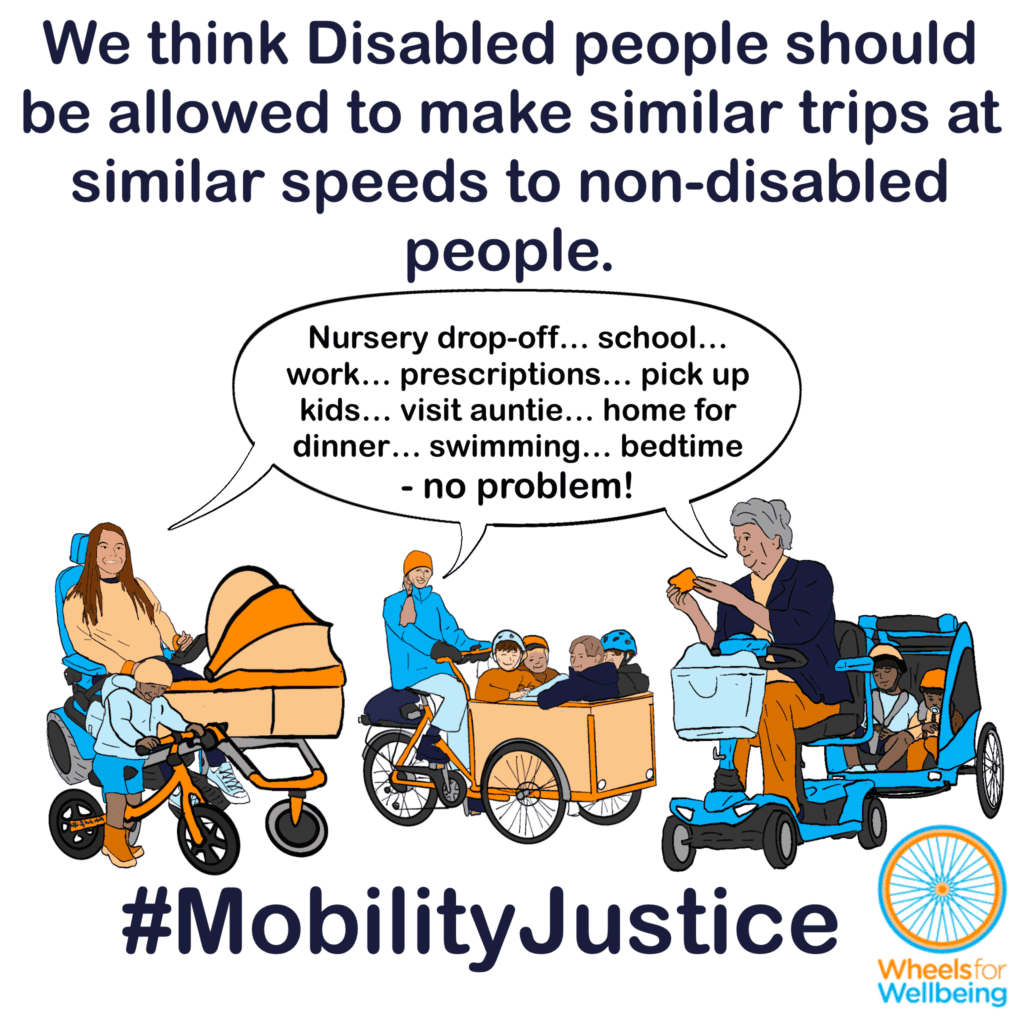
Why can’t Disabled people already make trips at similar speeds to non-disabled people?
In the UK at present, laws about “invalid carriages” largely determine what mobility aids Disabled people can use.
The law says that “invalid carriages” may only be used at a maximum powered speed of 4mph on all pedestrian spaces. These laws say that for all manual and powered wheelchairs, mobility scooters and other powered mobility aids, “footways” includes all footways (pavements), footpaths, bridleways and restricted byways. Cycle tracks are included as footways too. All together, that means people using wheelchairs and mobility scooters can only be powered at up to 4mph on traffic-free routes which people using cycles can use at any speed, and where e-cycles and trial scheme e-scooters can be powered at up to 15.5mph.[1]
Class 3 “invalid carriages” can have a maximum powered speed up to 8mph – but speeds above 4mph are only permitted on roads. Government guidance says “invalid carriages” may not be used on cycle lanes or bus lanes on roads – even though people can cycle in cycle lanes and bus lanes, and even though cycle lanes and bus lanes will generally be much safer spaces to be in than the adjacent road carriageway that “invalid carriage” users have the right to go on!
Mobility scooters, powerchairs, innovative aids and power attachments can already be safety certified for maximum powered speeds up to 20kph, (12.4mph) under existing British Standards.[2] Devices with this certification still can’t legally be used at above 4mph/8mph in public spaces in the UK.
Disabled children under 14 are only allowed devices that go up to 4mph – which prevents many Disabled children from taking part in activities and making journeys such as travelling to school independently or with their friends and family.[3]
Having aids that go above walking speeds opens up options for work, education and more:
Many Disabled people can’t drive, and often can’t practically use other modes including taxis or public transport for many trips.
Disabled people who are able to use cycles and e-cycles can go above walking speed – but can’t legally use our devices on pavements at all, even for a final few metres to reach or leave our own homes.
Steph told us how using an e-cycle which can travel above walking speed can enable her to attend medical appointments without having to take too much time off work:[4]
I’m waiting on some medical thing where you have to go in about three or four times a week. The local hospital would take me probably a round trip of three to four hours if I did it by public transport, but I can get that down to perhaps two hours if I do it cycling, including the treatment. So what we worked out was being able to cycle it reduces the amount of time I have to have off work.”
Being able to combine and switch mobility aids for longer and shorter distance use is important for many people
I want to be able to drive a cabin car mobility scooter pulling a trailer with my powerchair on under a tarp. The cabin cars go further than I can do on my powerchair & are protected from the weather. But when I get somewhere like the supermarket or museum etc I wouldn’t be able to go in in the cabin car, so I’d need my powerchair. If this setup was allowed I could actually go more places for days out/do more.
Also 8mph on a busy road is unsafe 12-15mph would actually be safer.”
What you can do
We want Disabled people to have the same journey-making choices as non-disabled people. For this to happen, we need the law to change. The Department for Transport is running a consultation into changing mobility aid laws. The consultation deadline is 22nd April 2026.
You can help make changes to improve mobility options for all Disabled people:
- Read our explainers and recommendations. We are concerned about some of the consultation wording and a lack of information on current laws in the consultation document. Without our extra information, case studies and links to other sources, we’re worried people could accidentally give answers that will cause problems for themselves or others.
- Once you’ve read and considered our explainers and recommendations, please respond to the Department for Transport’s consultation.
The information in this sheet directly links to consultation questions 20, 21 and 22, and indirectly to a range of other questions, including 10-13.
We are releasing free resources about all areas of mobility aid regulations to cover all aspects of the consultation as quickly as we can. Resources include written information, case studies, graphics, social media and webinars.
Follow all our information updates and find out more about how changes to the law can improve mobility for Disabled people on Bluesky, LinkedIn, Instagram and Facebook.
Contact us with comments, questions and suggestions at info@wheelsforwellbeing.org.
Join our free peer-support campaigning forum for Disabled people and allies.
Sign up for our newsletter (bottom of page)
References
[1] See mobility device information and sources spreadsheet for details: https://wheelsforwellbeing.org.uk/wp-content/uploads/2026/02/My-Mobility-device-information-and-sources-v06.xlsx
[2] BS EN 12184:2022 Electrically powered wheelchair, scooters and their chargers. Requirements and test methods https://knowledge.bsigroup.com/products/electrically-powered-wheelchairs-scooters-and-their-chargers-requirements-and-test-methods
[3] See “Disabled children should be allowed powered aids that let them run, cycle and explore with their friends” https://wheelsforwellbeing.org.uk/disabled-children-powered-aids/
[4] See Steph’s ICE Trike blog: https://wheelsforwellbeing.org.uk/case-study-stephs-ice-trike-and-the-cycle-to-work-scheme/
[5] For more details see the Every Journey Everyone campaign page, including this Preliminary Considerations document: https://wheelsforwellbeing.org.uk/considerations-dft-mobility-devices-consultation/
[6] “Not more than one person may be carried on a road on a bicycle not propelled by mechanical power unless it is constructed or adapted for the carriage of more than one person.” (Road Traffic Act 1988 s24(1)) https://www.legislation.gov.uk/ukpga/1988/52/section/24.
[7] The same rules for passengers apply to e-assist pedal cycles as to unpowered cycles, see: The Electrically Assisted Pedal Cycles (Amendment) Regulations (2015) https://www.legislation.gov.uk/uksi/2015/24/made and The Electrically Assisted Pedal Cycles Regulations (1983) https://www.legislation.gov.uk/uksi/1983/1168/made
[8] Wheels for Wellbeing Quick Guide to the Equality Act 2010 https://wheelsforwellbeing.org.uk/wheels-for-wellbeing-quick-guide-to-the-equality-act-2010/
[9] Mental Capacity Act 2005 https://www.legislation.gov.uk/ukpga/2005/9/contents
Please donate to support our work if you can:
Wheels for Wellbeing is a small Disabled People’s Organisation – a charity run by and for Disabled people. We depend on donations for our campaigning work: very few grants are available for campaigning.
Any donation you can make helps us keep working to achieve mobility justice for all.
#MobilityJustice #EveryJourneyEveryone