
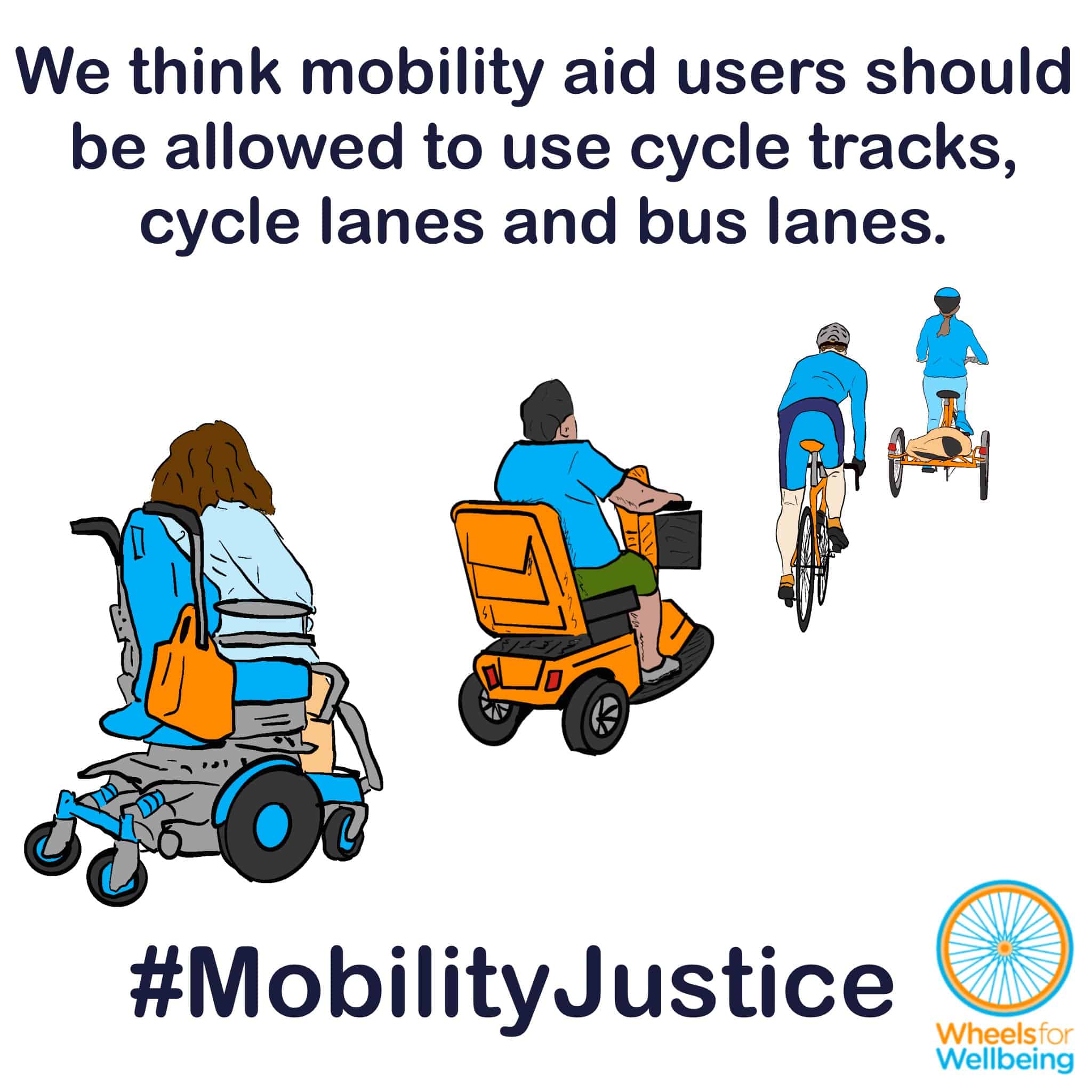
Why can’t mobility aid users use cycle lanes, tracks and bus lanes?
In the UK at present, laws about “invalid carriages” largely determine where Disabled people can use mobility aids. Mobility aid users are generally allowed to use off-road cycle tracks, but not on-road cycle lanes or bus lanes – even though people cycling on similar sized devices at similar speeds are allowed to use all these spaces.
“But nobody’s going to enforce those rules – just use the cycle lane anyway!”
Mobility scooter users and other powered mobility users often already do use cycle lanes and bus lanes – either because they don’t realise they’re not supposed to, or because they’d rather break this nonsensical and unsafe law than risk injury or abuse from drivers.
Even if there’s low risk of enforcement, it’s not fair to force Disabled people to break the law to use safe routes to make journeys. Disabled people are already at increased risk of harassment and assault, and at increased risk of being injured or killed by drivers.[i]
“OK, so just use the pavement – or get the bus!”
Mobility device users are only allowed to travel at 4mph on pavements – which is too slow to make many local journeys like school runs, commutes and caring trips in a timely fashion.
Many pavements are not safe or accessible, due to broken surfaces, steep gradients, missing dropped kerbs and obstructions like parked cars, bins and overgrown hedges.[ii]
People using mobility aids suitable for longer journeys or travel on rough terrain including many pavements aren’t usually allowed onto buses, trams or trains – or into taxis.[iii]
Disabled people need to be able to make complete local journeys, at above walking speed, using our safe, well-regulated mobility devices.
Legalising use of all active travel routes for Disabled people using mobility devices would make journey-making safer for all of us, enabling more Disabled people to be physically active, make the trips we need to for work, education, healthcare, leisure and more, and take part fully in our communities.
What legal changes do we need?
A small number of legal changes would make big differences to different accessible mobility options for a lot of different people. You may notice that this legal changes section is the same or similar in some of the other case studies in this series!
We want new mobility aid laws to be fit for purpose, fair and future-proofed.
- We think that Disabled people using appropriate mobility devices [iv] at pedestrian speeds should be recognised in law as pedestrians, just the same as people walking or running.
- We think that people using appropriate mobility devices at above pedestrian speeds (“amplified mobility” [v]) should be treated in law as equivalent to people cycling.
- We think pedestrians, including Disabled people using appropriate mobility devices, should continue to be allowed to use all highway and public spaces (with limited exceptions e.g. motorways, specific bridges and tunnels).
- We think people using amplified mobility at above pedestrian speeds should be allowed to use all highways and public spaces except spaces where only pedestrians are permitted (with limited exceptions as above).
This isn’t radical – it would simply remove confusion and make the law consistent for people using all comparable devices. We’ve found through consultation that many people think these suggested rules are what the law already says! [vi]
- Pedestrians are already allowed to use road carriageways as well as pavements – there are no “jaywalking” laws in the UK.
- Our understanding is that current laws allow all “invalid carriage” users to use carriageways as well as footways (pavements).[vii]
What you can do
We want Disabled people to have the same journey-making choices as non-disabled people. For this to happen, we need the law to change. The Department for Transport is running a 15-week consultation into changing mobility aid laws. The consultation deadline is 22nd April 2026.
You can help make changes to improve mobility options for all Disabled people:
- Read our explainers and recommendations. These should all be released by mid February 2026. We are concerned about some of the consultation wording and a lack of information on current laws in the consultation document. Without our extra information, case studies and links to other sources, we’re worried people could accidentally give answers that will cause problems for themselves or others.
- Once you’ve read and considered our explainers and recommendations, please respond to the Department for Transport’s consultation.
The information in this sheet directly links to consultation questions 8, 9, 24-27, 30, and can be used to support answers to many other questions.
We are releasing free resources about all areas of mobility aid regulations to cover all aspects of the consultation as quickly as we can. Resources include written information, case studies, graphics, social media and webinars.
Follow all our information updates and find out more about how changes to the law can improve mobility for Disabled people on Bluesky, LinkedIn, Instagram and Facebook.
Contact us with comments, questions and suggestions at info@wheelsforwellbeing.org.
Join our free peer-support campaigning forum for Disabled people and allies.
Sign up for our newsletter (bottom of page)
References
[i] See https://www.sciencedirect.com/science/article/pii/S1353829222001575 and https://roadsafetygb.org.uk/news/disabled-and-low-income-pedestrians-at-higher-risk-of-road-injury/
[ii] Transport for All “Are we there yet? Barriers to transport for disabled people in 2023” https://www.transportforall.org.uk/blog/2023/12/05/are-we-there-yet-barriers-to-transport-for-disabled-people-in-2023/
[iii] See reference above
[iv] See further documents in this series: We suggest mobility device categories with different rights of access to indoor spaces, public transport and outdoor spaces relating to device size, weight and manoeuvrability.
[v] See reference above
[vi] Wheels for Wellbeing consultations on mobility aids regulations – internal documents, 2022-2026
[vii] See section 6 “invalid carriages” of the Wheels for Wellbeing Guide to Mobility Aids (2025) for full explanation including references to existing guidance and laws https://wheelsforwellbeing.org.uk/wheels-for-wellbeing-guide-to-mobility-aids-2/
Please donate to support our work if you can
Wheels for Wellbeing is a small Disabled People’s Organisation – a charity run by and for Disabled people. We depend on donations for our campaigning work: very few grants are available for campaigning.
Any donation you can make helps us keep working to achieve mobility justice for all.
#MobilityJustice #EveryJourneyEveryone