
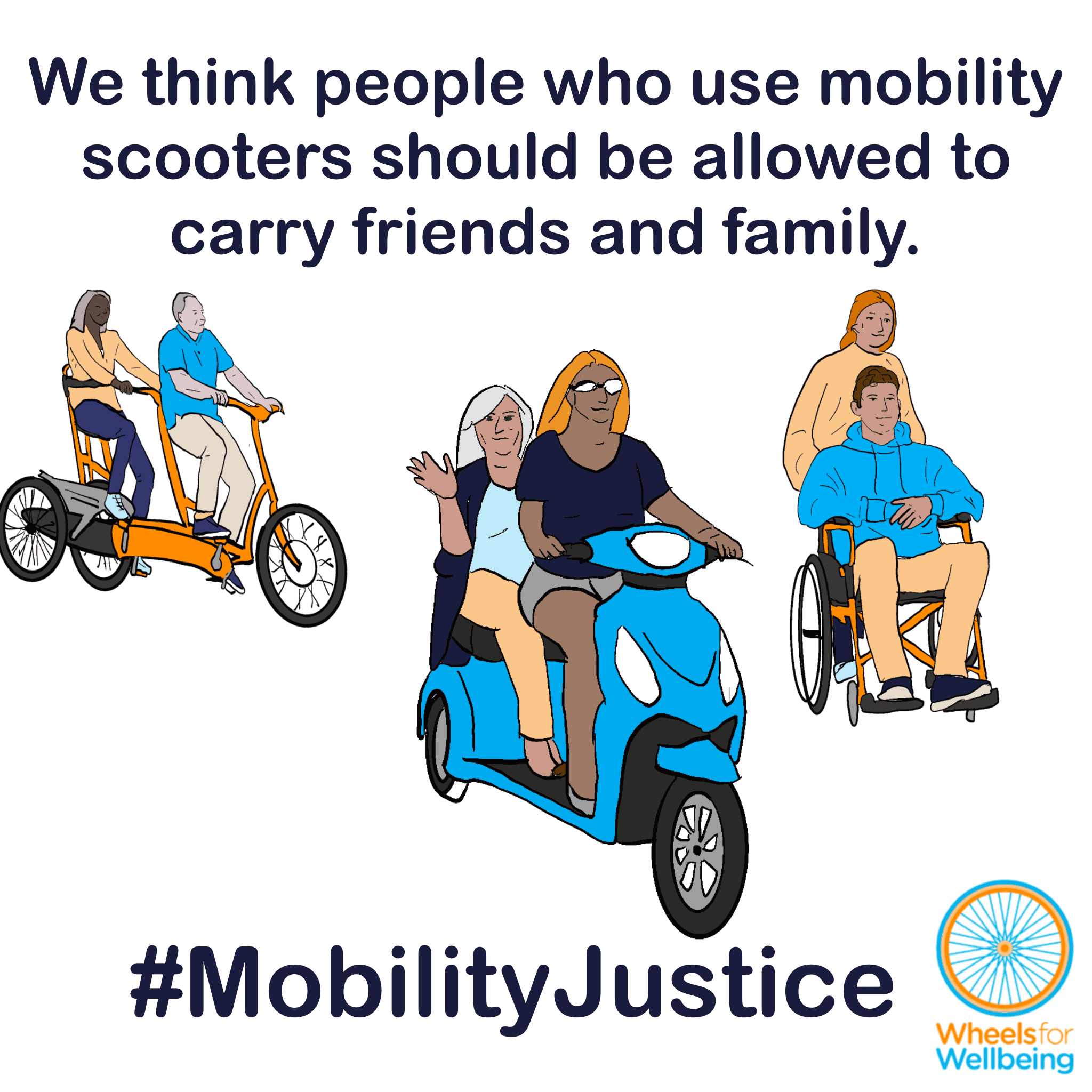
Why can’t people already use two-person mobility scooters?
David explained to us in a recent blog why he and his wife Gill love their tandem mobility scooter :
I bought a used mobility scooter a year ago and it gets me to town – a round trip of 4 miles. We have a token bus service – two a day, but taxis are the only real means of getting around. My wife lacks the confidence to drive a mobility scooter even on the pavements: finding dropped kerbs can be a nightmare.
Alfred says a tandem scooter would help him and his wife keep caring for each other:
I have severe balance problems and have a mobility scooter. My Wife who has been my carer for some six years has developed dementia and finds it difficult to get around. A tandem scooter would make all the difference.
Tom wants to give up driving. A tandem mobility scooter would make that possible:
I am 83 years of age my wife is 80 we are 2 miles away from town, I still drive, but would love to stop! We have a Mercedes 4×4 diesel Automatic and a Mercedes Camper Automatic and would love to be able to buy a double mobility Scooter neither of us can walk more than a few yards. I have a blue badge and I have Spina Bifida. And to stop driving would be a blessing.
Legalising tandem mobility scooters and other multi-person mobility aids would make a huge difference to many thousands of people’s independence, health and participation in society each year – and could help reduce road collision injuries, reduce congestion and improve air quality too.
What legal changes do we need?
A small number of legal changes would make big differences to different accessible mobility options for a lot of different people. You may notice that this legal changes section is the same or similar in some of the other case studies in this series!
We want new mobility aid laws to be fit for purpose, fair and future-proofed.
- We think that more than one person should be able to use a mobility aid at a time, as long as the aid is constructed or adapted to carry more than one person.
- We think that mobility aids should be allowed to pull or push trailers for people or luggage, as long as these are safely attached.[i]
- We think that mobility aids designed or adapted to be connected in “trains” to each other or alternative compatible devices (such as suitable cycles) should be allowed.
This isn’t radical – we want the rules for people using powered mobility aids to be the same as existing rules for people walking, running, using cycles [ii] or e-cycles! [iii]
- People walking or running are allowed to pull or push luggage, shopping and other people using wheelchairs, pushchairs, trolleys and cases.
- Single, double, triple and even quad pushchairs and joggers are often used, by parents, carers, childminders and nurseries.
- Cycles and e-cycles which can transport multiple people including adults and children are legal in the UK.
- People cycling are allowed to carry cargo, tow trailers, attach child seats, and connect cycles together using towbars, tow ropes and other devices. [iv]
What you can do
We want Disabled people to have the same journey-making choices as non-disabled people. For this to happen, we need the law to change. The Department for Transport is running a 15-week consultation into changing mobility aid laws. The consultation deadline is 22nd April 2026.
You can help make changes to improve mobility options for all Disabled people:
- Read our explainers and recommendations. These should all be released by mid February 2026. We are concerned about some of the consultation wording and a lack of information on current laws in the consultation document. Without our extra information, case studies and links to other sources, we’re worried people could accidentally give answers that will cause problems for themselves or others.
- Once you’ve read and considered our explainers and recommendations, please respond to the Department for Transport’s consultation.
The information in this sheet directly links to consultation questions 20, 21 and 22, and indirectly to a range of other questions, including 10-13.
We are releasing free resources about all areas of mobility aid regulations to cover all aspects of the consultation as quickly as we can. Resources include written information, case studies, graphics, social media and webinars.
Follow all our information updates and find out more about how changes to the law can improve mobility for Disabled people on Bluesky, LinkedIn, Instagram and Facebook.
Contact us with comments, questions and suggestions at info@wheelsforwellbeing.org.
Join our free peer-support campaigning forum for Disabled people and allies.
Sign up for our newsletter (bottom of page)
References
[i] “Invalid carriages” are presently not permitted to have trailers attached in any circumstances. (Road Vehicles (Construction and Use) regulations 1986 s83) https://www.legislation.gov.uk/uksi/1986/1078
[ii] “Not more than one person may be carried on a road on a bicycle not propelled by mechanical power unless it is constructed or adapted for the carriage of more than one person.” (Road Traffic Act 1988 s24(1)) https://www.legislation.gov.uk/ukpga/1988/52/section/24.
[iii] The same rules for passengers apply to e-assist pedal cycles as to unpowered cycles, see: The Electrically Assisted Pedal Cycles (Amendment) Regulations (2015) https://www.legislation.gov.uk/uksi/2015/24/made and The Electrically Assisted Pedal Cycles Regulations (1983) https://www.legislation.gov.uk/uksi/1983/1168/made
[iv] In the UK, cycles are “carriages”, not “road vehicles” or “motor vehicles”, meaning many motor vehicle rules do not apply to cycles (Local Government Act 1888 s 85) https://www.legislation.gov.uk/ukpga/Vict/51-52/41 . Construction and use regulations for cycles do not mention trailers – see: The Pedal Cycles ((Construction and Use) Regulations 1983 and The Pedal Cycles (Construction and Use) (Amendment) Regulations 2015 https://www.legislation.gov.uk/uksi/2015/474/made
Please donate to support our work if you can
Wheels for Wellbeing is a small Disabled People’s Organisation – a charity run by and for Disabled people. We depend on donations for our campaigning work: very few grants are available for campaigning.
Any donation you can make helps us keep working to achieve mobility justice for all.
#MobilityJustice #EveryJourneyEveryone