
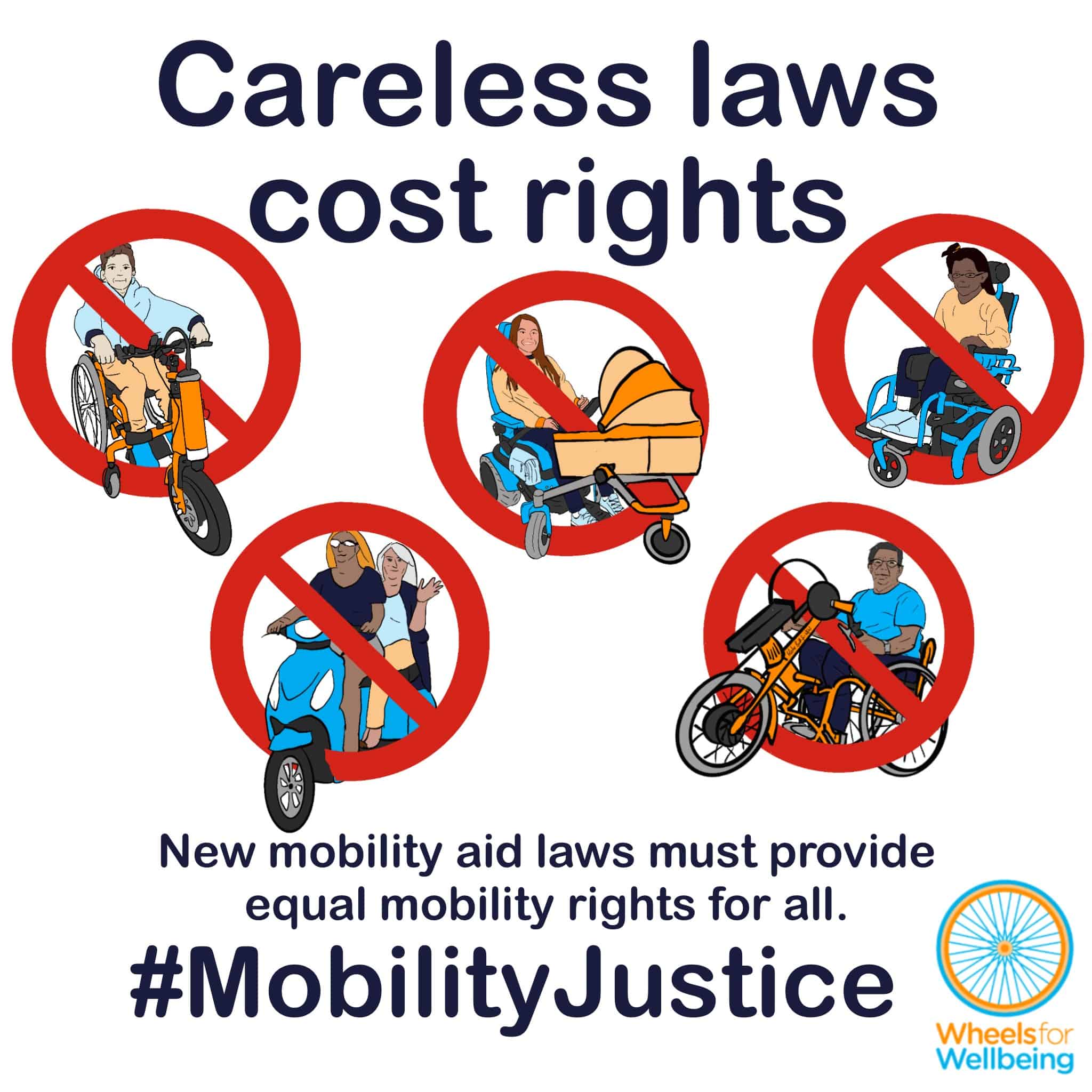
How can we ensure new mobility aid regulations support equal mobility for all?
Overview
Wheels for Wellbeing are a nationally and internationally recognised pan-impairment Disabled People’s Organisation working for equal access to walking/wheeling, cycling and multi-modal journeys for all Disabled people. We have been consulting with Disabled People’s Organisations, charities, industry bodies and Disabled individuals on inclusive requirements for changes to mobility aid laws for a number of years.
The Department for Transport are consulting until 22nd April 2026 on possible changes to mobility aid regulations.
Existing UK mobility aid regulations are not fit for purpose: We strongly support changes to improve them. New regulations must align with the Equality Act (2010), and the UNCRPD which states that signatory nations, including the UK, must take: “effective measures to ensure personal mobility withgreatest possible independence for persons with disabilities”, facilitating Disabled people’s mobility “in a manner and at the time of their choice.”
We are worried that some consultation wording, the lack of easily-available, accurate background information and stereotypes about Disabled people could prevent positive legal changes from happening. It could even lead to changes that could make mobility options worse for some Disabled people.
This document outlines our most serious concerns and some potential solutions.
The section order is for readability and flow, and does not indicate any prioritisation of particular concerns above others.
We ask that you wait to respond to the DfT consultation until you’ve been able to read our resources, watch our webinar, and consider our points, so that your response is fully informed. We anticipate all our initial resources will be available on the Wheels for Wellbeing mobility aids regulation campaign page by mid-February 2026.
1. Families and friends
Please refer to: DfT consultation overview of current legislation, questions 5, 6, 10-13, 20-27 and associated text
Key issues:
The consultation suggests allowing one passenger on mobility devices, and requests perspectives on restricting passengers by age, relationship to disabled person, restraints, carer status etc. A minimum age is suggested. The consultation does not mention attachments, trailers, connecting mobility devices together, or powered pedestrian-propelled devices.
See also children and young people section.
- Yes, permitting one adult passenger on mobility devices could open options for Disabled couples and friends – depending on other restrictions.
- But any minimum age limit for passengers will continue to exclude Disabled parents from transporting our own babies and children, whether on our mobility aids, or using attachments comparable to pushchairs or cycle seats/trailers.
- A one-passenger limit will exclude from using mobility devices Disabled parents with more than one child, or families where one parent/carer has a disability that means they cannot safely control a mobility device (e.g. a Blind parent).
- Retaining requirements for users to be Disabled would continue to exclude non-disabled family members and friends of Disabled people from making practical local journeys: for example, nobody can safely push a manual wheelchair while pushing a pushchair, so a non-disabled person would need to use a mobility device to transport their Disabled partner or other relative and young children simultaneously.
- Additional unevidenced restrictions for mobility aid construction and use such as seatbelts would inevitably unreasonably exclude some people from using otherwise suitable mobility aids.
- Weight limits set too low could both exclude people from using aids with necessary equipment attached and prohibit some multi-person devices, as could aligning wider mobility device requirements with class 3 mobility device regulations.
- Without explicit permission for pedestrians to use self-propelling or e-assist pushchairs and cargo-carrying devices, Disabled people who can walk but who cannot push heavy items such as buggies and shopping carts or luggage will remain excluded from making active local journeys, especially in hilly places.
To develop future-proofed mobility equality:
- There should be no specified maximum number of passengers on mobility devices.
- Trailers, towed mobility devices and attachments for people and/or cargo should be explicitly permitted.
- The requirement for people using mobility devices to be Disabled or mobility impaired should be removed.
- Self-propelling or e-assist pedestrian-controlled passenger and cargo devices should be explicitly permitted.
This would align multi-person and towing regulations with existing cycle regulations. No cycle types are restricted according to disability.
We further suggest new mobility device categories should be created, giving users of devices in each category the right to use their device safely in all appropriate spaces. See device classification section for details.
2. Children and young people
Please refer to: DfT consultation overview of current legislation, questions 8, 9, 18, 19, 20-27 and associated text.
See families and friends section for issues relating to children travelling on mobility devices with parents/carers.
Key issues:
“Mobility device” is the consultation’s proposed new term for “invalid carriage”. Class 1 and 2 “invalid carriages” presently include all unpowered and powered wheelchairs and mobility scooters legal for use by children in the UK. Under-14s may not use class 3 “invalid carriages”.
Consultation questions 18 and 19 consult about a minimum age for users of all “mobility devices”, and a minimum age for use of “mobility devices” on road. Question phrasing is likely to prompt many respondents to suggest mobility device users should be at least 14.
Questions 24-27 appear to propose alignment of regulations for use of power attachments and some cycle types with class 3 “invalid carriage” regulations.
The consultation does not mention children explicitly as users or people who could benefit from being users of power attachments, cycles, or other less widely recognised mobility aids.
- There is currently no minimum age for users of class 1 and 2 “invalid carriages”. There should never be a minimum age for “mobility device” users: this would remove independent mobility from all Disabled children below that age, who need to use unpowered or powered wheelchairs and other comparable devices, and render them immobile until they reach the prescribed age.
- Prohibiting specific device users and/or people under 14 from using their aids on road would remove existing pedestrian rights. It would prevent children in areas with poor or no pavements from accessing their own communities.
- It is not possible, practical or useful to make most power attachments or handcycles meet existing class 3 regulations: this change would require manual wheelchair users with easily-detachable power attachments including e-assist wheels to have permanently-fitted brake lights, indicators, hazard warning lights, a rear-view mirror and more – see device classification section.
- Aligning regulations for power attachments, handcycles and other new or less recognised mobility aids with current class 3 regulations would:
-
- Exclude Disabled children who use power attachments, e-assist wheels and comparable devices which are currently class 2 “invalid carriages” from continuing to use these highly functional aids.
- Continue to exclude Disabled children who need powered aids from moving at above walking speed. See speeds and safety section.
- Continue to exclude many Disabled children from moving at all on surfaces such as soft grass, muddy playgrounds, gravel, sand and snow. See device specification section.
- Regulating any cycles as class 3 “invalid carriages” would exclude children under 14 who currently cycle from using these devices. It would continue excluding children needing e-assist to cycle from all cycling, including cycling to school.
- Exclude Disabled children who use power attachments, e-assist wheels and comparable devices which are currently class 2 “invalid carriages” from continuing to use these highly functional aids.
To develop future-proofed mobility equality:
- No age restrictions should be applied to any devices presently recognised as “not in class”, class 1 or class 2 “invalid carriages”.
- Age restrictions on class 3 “invalid carriages” should be removed. Children, their families and relevant professionals should determine appropriate devices and functions individually, just as for non-disabled children who walk, scoot or cycle.
Powered mobility device software typically allows bespoke top speeds to be set.
Anti-collision and hazard avoidance devices similar to vehicle systems can be fitted to various mobility aids.
We believe age restrictions on e-assist pedal cycles should be lifted. This would align UK regulations with many other countries, permitting Disabled children needing e-assist to cycle within the law and in line with government targets for reducing car dependency, improving children’s health and promoting active travel (see also speeds and safety section)
3. Speeds and safety
Please refer to: DfT consultation overview of current legislation, questions 8, 9, 14-17, 24-27 and 30, and associated text.
Key issues:
The consultation asks about permitting mobility device use at above 8mph on cycle lanes and roads. It quotes NHS advice that walking speed is 3mph. No additional context on typical pedestrian and cycling speeds including expected speed variability, the rights non-disabled people already have to pedestrian and cycling speed mobility, or government aspirations for active travel and reduced motor vehicle use are given.
Typical pedestrian and cycling speeds:
| Activity | Typical speed |
| Minimum walking speed to use most pedestrian crossings | 2.7mph/ 4.3kph (1.2m/s) |
| Brisk walk (British Heart Foundation) | 4mph/ 6.4kph |
| Maximum permitted speed of powered mobility aids on pavements | 4mph/ 6.4kph |
| Long-distance jogging, typical casual amateur speed | 8mph/ 12.9kph |
| Maximum permitted speed of powered mobility aids on roads, not pavements | 8mph/ 12.9kph |
| Long distance running, fast speed | 12.4mph/ 20kph |
| Maximum speed for certified British Standard powerchairs and mobility scooters (this is for device safety testing. The “invalid carriages” legal top speed on UK public land including roads is 8mph). | 12.4mph/ 20kph |
| Maximum powered speed for legal e-cycles and e-scooters (e-cycles can be pedaled or roll faster than this speed). | 15.5mph/ 25kph |
| Professional sprinter | 22mph/ 36kph (10m/s) |
| Cycle freewheeling down a steep hill | Over 30mph/ 50kph |
- Mobility aid users will remain excluded from making local journeys at speeds comparable to cycling or jogging/running if devices remain limited to 4/8mph. The extra time required for Disabled people’s journeys compared to non-disabled people’s journeys will continue to exclude many Disabled people from education, work and participation in society.
The issue particularly affects Disabled carers who lack the option to drive. These carers are disproportionately women and from minoritised ethnicities. Carers disproportionately need to “chain” trips with tight time constraints, for example dropping a child at nursery or meeting a family member’s care needs, then getting to work on time, going to an appointment in a break and the reverse later in the day. - Low maximum permitted speeds exclude mobility aid users from normal activities, including rushing to get to a bus, or keeping up with small children or with friends who are jogging or cycling, or preventing a child from coming to harm, for example, if the child is running towards a road or other danger.
- Low maximum permitted speeds mean mobility aid users cannot move at running or cycling speeds to get out of danger, including escaping from harassment, abuse and assaults or from dangerous drivers– including drivers who may not have noticed us. Low mobility aid maximum speeds could increase Disabled people’s risk of injury and other harms.
To develop future-proofed mobility equality:
- Disabled people should have the explicit right to use mobility aids at pedestrian speeds in all pedestrian spaces.
- Disabled people should have the explicit right to use mobility aids at cycling-equivalent speeds in all cycle-permitted spaces.
We recommend maximum powered speeds for mobility devices used in public spaces should be aligned with either current e-assist pedal cycle maximum powered speeds (15.5mph/25kph) or upcoming micromobility maximum powered speeds, potentially 12mph/20kph.
Maximum powered speeds and other features for specific devices should be determined by product safety requirements. British Standards for powered wheelchairs and mobility scooters already permit powered speeds of 12mph/20kph.
4. Device classification and specifications
Please refer to: DfT consultation overview of current legislation, questions 10-13, 24-27 and 30, and associated text.
Key issues:
The consultation discusses device weights without outlining the complex additional requirements for devices to legally be class 3 “invalid carriages”. Existing regulation for comparable devices like cycles is not outlined. Factors such as device dimensions are not discussed.
- The 113.4kg limit for class 2 “invalid carriages” prevents children under 14 who need heavier aids and equipment from using suitable devices legally: children under 14 cannot use class 3 devices, which have higher weight limits. This regulation puts children with complex health needs and their families in potential legal jeopardy. Since 2015 in Wales, all classes of “invalid carriage” may have unladen weights up to 200kg if required for essential equipment. Children in Wales have better access to legal mobility options than children in the rest of the UK.
- Class 2 “invalid carriages” are typically not capable of travelling more than very short distances or travelling on unmade or uneven terrain:
- The class 3 age restriction excludes children from using devices suitable for soft grass, gravel, slippery leaves, steep slopes, or even on uneven pavements.
- Many NHS services do not provide class 3 devices, effectively excluding many Disabled adults from moving around communities, especially villages, or green spaces and even their own gardens.
- Class 3 mobility aids have maximum speed 8mph, a 4mph restrictor switch, fixed headlight and rear light, indicators, hazard lights, brake light, rear-view mirror and horn.
- If required to meet class 3 criteria, Disabled people who use or would benefit from using power attachments and other newer aids will be increasingly excluded from using safe, practical aids including e-assist and detachable aids which promote physical activity and improve users’ health. This will affect most manual wheelchair users, including people who could switch from using powerchairs to using manual chairs if powered options for longer-distance movement were permitted:
It is not reasonable or even possible for many newer mobility options to meet full class 3 requirements. Requiring such devices to meet class 3 would prohibit their use in public spaces – even where such devices are presently legal class 2 aids. - Many public transport providers do not allow class 3 mobility scooters onto services. Aligning regulations for newer aids, such as power add-ons, with class 3 “invalid carriages” risks increasing exclusion of Disabled people from public transport.
- If required to meet class 3 criteria, Disabled people who use or would benefit from using power attachments and other newer aids will be increasingly excluded from using safe, practical aids including e-assist and detachable aids which promote physical activity and improve users’ health. This will affect most manual wheelchair users, including people who could switch from using powerchairs to using manual chairs if powered options for longer-distance movement were permitted:
- Lack of rights to use less well recognised devices as mobility aids, including cycles and other powered and unpowered aids, excludes many Disabled people from safe, practical, cost-effective devices for making local journeys. This particularly affects people on low incomes, people living in flats and temporary accommodation, and Disabled people who care for children and/or other Disabled people.
To develop future-proofed mobility equality:
- Disabled people must have the right to be regarded in law as pedestrians while using mobility aids at pedestrian speeds in all pedestrian spaces.
- Disabled people must have the legal right to use our mobility aids at cycling or cycling-equivalent speeds in all cycle-permitted spaces.
- New mobility device categories are needed to support the above rights of Disabled people to use all suitable mobility devices in all appropriate spaces.
We suggest three device categories could be sufficient, with defined factors including maximum device dimensions, weight and potentially manoeuvrability for each category. All devices within these categories that a Disabled person is using for pedestrian mobility, should be legally recognised as mobility aids. This would enable Disabled people to use devices such as power add-ons, cycles, e-cycles, e-scooters and devices that have not yet been invented as our mobility aids.
We suggest that Disabled people should have a clear right to use:
- An “everyday device” category in all spaces, including in homes, all service provider venues, all public transport and all public spaces. This would be the most common device category. It would need to encompass all existing wheelchairs and most mobility scooters, and all other comparable devices when used as mobility aids.
- A middle category device in all public transport and all public spaces, and to access other spaces as reasonable. The maximum dimensions for this category should be considerably larger than the existing “reference wheelchair” in PSVAR and RVAR, which presently is so small that DfT-commissioned research published in 2022 found the size requirements exclude 46% of all wheelchair and mobility scooter users.
- An outsize category device in all public spaces, and to access other spaces as reasonable. This would include very large devices such as non-separable multi-person aids, for example large non-standard cycles.
5. Using mobility aids safely in public spaces
Please refer to: DfT consultation overview of the current legislation, objectives 3 and 4, questions 8, 9, 14-17, 24-27, 30 and associated consultation text.
Key issues:
The consultation discusses permissions for mobility aid users for a range of highway spaces, including pavements, roads, cycle lanes and cycle tracks. Bus lanes are not mentioned. Suggestions include prohibiting a range of mobility aid users from using roads, including users of power attachments and handcycles.
The consultation states class 1 and 2 “invalid carriages” “can be used on the road where there is no pavement available”, incorrectly implying people using class 1 and 2 “invalid carriages” are not legally permitted to use the road if there is a pavement.
- Disabled people will continue to be excluded from using safe, practical devices unless we are permitted to use all mobility aids at appropriate pedestrian speeds in pedestrian spaces: if you cannot dismount and walk to a destination, and may not use your mobility aid on the pavement you simply cannot legally complete your journey – or even leave your home to start it!
- There are no “jaywalking” laws in the UK: Pedestrians have a right to use all roads (except specific roads like motorways, some bridges and tunnels). Banning mobility aid users under 14 and/or those using specific aids from using roads would create discriminatory “jaywalking” laws that would only apply to specific groups of Disabled people, not to non-disabled people. Such laws would exclude Disabled people from using the many UK roads that have no pavements, and those with poor-quality or obstructed pavements.
- People using cycles very comparable to mobility devices are permitted to use all cycle lanes, cycle tracks, bus lanes and roads.
Continuing to exclude people using mobility aids from cycle-permitted spaces prevents Disabled people from making safe journeys to destinations such as workplaces, schools, healthcare and shops, and restricts Disabled people to either using pavements at walking speed, or sharing road space with motor vehicles if we need to move faster:- Mobility aid users who need to travel at above walking speed are put at increased risk of injury or death in collisions with drivers.
- Mobility aid users travelling at walking speeds on routes without safe pavements are, again, put at increased risk of injury or death.
- Excluding mobility aid users from cycle lanes, tracks and bus lanes requires more people to use pavements. Requiring more mobility aid users to use pavements will increase risk of injuries, from tipping over on these often poor-quality spaces and collisions.
- Continuing to exclude Disabled people from running-equivalent and cycling or cycling-equivalent speeds may increase road injury collisions and other motor vehicle-linked harms, as well as preventing Disabled people escaping from dangerous situations – see risks and benefits section.
To develop future-proofed mobility equality:
- Mobility aid users must have the right to use all pedestrian, cycling and road spaces (except limited restrictions to pedestrians and cyclists such as motorways).
- Regulations and guidance including the Highway Code should reflect that many pavements are unsafe and/or inaccessible.
- Responsible use of mobility devices by Disabled people should be governed by the same regulations that already prohibit dangerous, and antisocial behaviour by all pedestrians and cyclists, as relevant to device type and its use at the time.
- High-quality, voluntary skills and safety training should be available for everyone using public spaces.
Powered mobility device and e-cycle software typically enables approved services to set top device speeds. Anti-collision and hazard avoidance devices comparable to vehicle systems can be fitted to many mobility aids.
Disabled people must not be excluded from mobility comparable to that of non-disabled people due to concerns about others’ irresponsible behaviour.
6. Supporting improved access to and use of mobility devices
Please refer to: DfT consultation overview of current legislation, objectives 1 and 2, questions 5, 6, 24-27, 30 and associated text.
Key issues:
Consultation objectives suggest differentiating “clinical need” and “allowing greater choice”. This implies different rights and permissions for different Disabled people using similar devices. The consultation implicitly supports retention of requirements for “invalid carriage” users to be recognised as Disabled or mobility impaired.
Questions 26-27 taken with 28-30 imply some cycles and e-cycles could be regulated as class 3 “invalid carriages” instead of as cycles.
See also all other sections of this document.
- Dividing mobility aid users by “need” will exacerbate difficulties faced by many Disabled people in achieving adequate mobility options. Retaining requirements for “invalid carriage” users to be Disabled worsens this issue. Tiered rights for Disabled people would be likely to:
- Exclude people who do not yet have a diagnosis from accessing mobility options that enable us to stay healthy, in work or education and caring for dependents. Medical recognition and access to services frequently takes years, for adults and children.
- Permanently exclude people who cannot gain formal recognition of our mobility impairments from making local journeys. This most severely impacts people who are already disproportionately excluded, including those less able to complete paperwork or communicate with services, and those less able to get to medical appointments – often due to a lack of suitable mobility options.
- Exclude Disabled families where an individual’s mobility requirements include caring for others. Assessments of “need” typically only consider an individual’s ability to move short distances in clinical settings, not allowing for our real lives, including family and caring needs.
- Disproportionately exclude people living in flats, and other homes with limited space or poor access from obtaining and using suitable mobility aids.
- Worsen exclusion of Disabled people from public transport and taxis, by inadvertently encouraging exclusion of some Disabled people using safe, compact mobility aids.
- Re-aligning regulation of any cycles or e-cycles with class 3 “invalid carriages” could:
- Exclude all Disabled children under 14 from using affected cycles.
- Mandate maximum speed of 8mph for affected cycles, restricting speeds for Disabled cyclists only, so creating far worse cycling rights for Disabled people than non-disabled people.
- Render affected cycles illegal to use in public spaces: e.g. it is unfeasible for any cycles which can freewheel to have 4mph restrictor switches, and unreasonable for detachable aids such as handcycle attachments to have brake lights and indicators, as these would have to be separately attached to a manual wheelchair.
- See device classification section for these issues relating to power attachments and similar aids.
To develop future-proofed mobility equality:
- Align UK mobility aid regulation with the Equality Act (2010) and UNCRPD, upholding Disabled people’s right to equal mobility.
- Continue to regulate all cycles and e-cycles under existing regulations.
- Put in law explicit rights to pedestrian and cycling-equivalent mobility for Disabled people using mobility aids.
- Introduce rights for Disabled people to use a wide range of devices as mobility aids. See device classification section.
There are requirements in the Equality Act to provide anticipatory reasonable adjustments for equality of access, and a right to mobility under the UNCRPD, to which the UK is a signatory. We don’t believe these can be met if one group of Disabled people are given better mobility rights than others.
7. Risks and benefits of improving mobility device regulation
Please refer to: DfT consultation overview of current legislation, question 30 and associated text.
Key issues:
The consultation asks respondents to suggest risks of allowing Disabled people to use mobility devices on pavements and in public places.
Benefits are not mentioned or requested.
See also supporting improved access to and use of mobility aids section.
There will be significant and widespread benefits to individuals, families, communities and society arising from improving mobility options for over 10 million UK mobility impaired people.
- Failing to consider benefits of regulatory change will result in over-representation of risks, and under-representation of benefits that likely far outweigh such risks. Many benefits apply both to mobility aid users and to people who are not mobility aid users, including Disabled people.
Failure to consider benefits is likely to result in over-restrictive regulation, causing harm and discrimination.
Some potential benefits of less restrictive mobility aid regulations include:- Reduction in injury collision risk to all pedestrians, if drivers feel they have viable alternatives.
This is especially relevant to older people, who often continue driving even though they or others are aware they can no longer drive safely, because at present, lack of suitable mobility aid options such as tandem mobility scooters with top speeds of 8-12mph means stopping driving would prevent them from completing important trips. - Health improvements for Disabled people, families and community members, including from exercise, time spent outdoors, social contact, financial wellbeing, self-care and care of dependents, e.g. ability to attend events and dependents’ healthcare appointments.
- Improvements in education, employment and financial status for Disabled people and families, including from improved ability to enter paid work, from improved independence and reduced care requirements for Disabled individuals reducing likelihood of family members giving up work or reducing paid hours.
- Reduction in injury collision risk to all pedestrians, if drivers feel they have viable alternatives.
To develop future-proofed mobility equality:
- Disabled people must have equal mobility rights to those enjoyed by non-disabled people, including the right to pedestrian, cycling and cycling-equivalent mobility.
- If restrictions to Disabled people’s pedestrian and cycling-equivalent mobility which do not apply to non-disabled people are retained or introduced, this inequality must be robustly justified, including full analysis of risks and benefits with clear evidence showing benefits of restrictions significantly outweigh risks of delivering equality for Disabled people
8. Synopsis: Ensuring mobility aid regulations help provide safe, practical mobility options for all Disabled people
We believe future-proofed mobility aid regulations allowing Disabled people the same journey-making options as non-disabled people can be made.
We believe adverse consequences can be avoided.
Simple approaches like modelling new regulations on proven examples in comparable parts of UK and international law can help achieve Disabled people’s right to equal mobility.
Further details and references are on the Wheels for Wellbeing mobility aid regulation campaign page and the Wheels for Wellbeing resources page We anticipate most or all relevant documents will be launched by mid February 2026.
Disabled people are best able to determine our own mobility aid requirements – just as people choose appropriate shoes to enable different activities.
Least-restrictive, safety-focused mobility aid regulations will facilitate Disabled people’s full participation in all areas of life.
Contacts and further information
Follow our information updates and find out more about how changes to the law can improve mobility for Disabled people on Facebook, Instagram, Bluesky and LinkedIn
Contact us with comments, questions and suggestions at info@wheelsforwellbeing.org.
Join our free peer-support campaigning forum for Disabled people and allies.
Sign up for our newsletter (bottom of page)
Please donate to support our work if you can
Wheels for Wellbeing is a small Disabled People’s Organisation – a charity run by and for Disabled people. We depend on donations for our campaigning work: very few grants are available for campaigning.
Any donation you can make helps us keep working to achieve mobility justice for all.
#MobilityJustice #EveryJourneyEveryone