
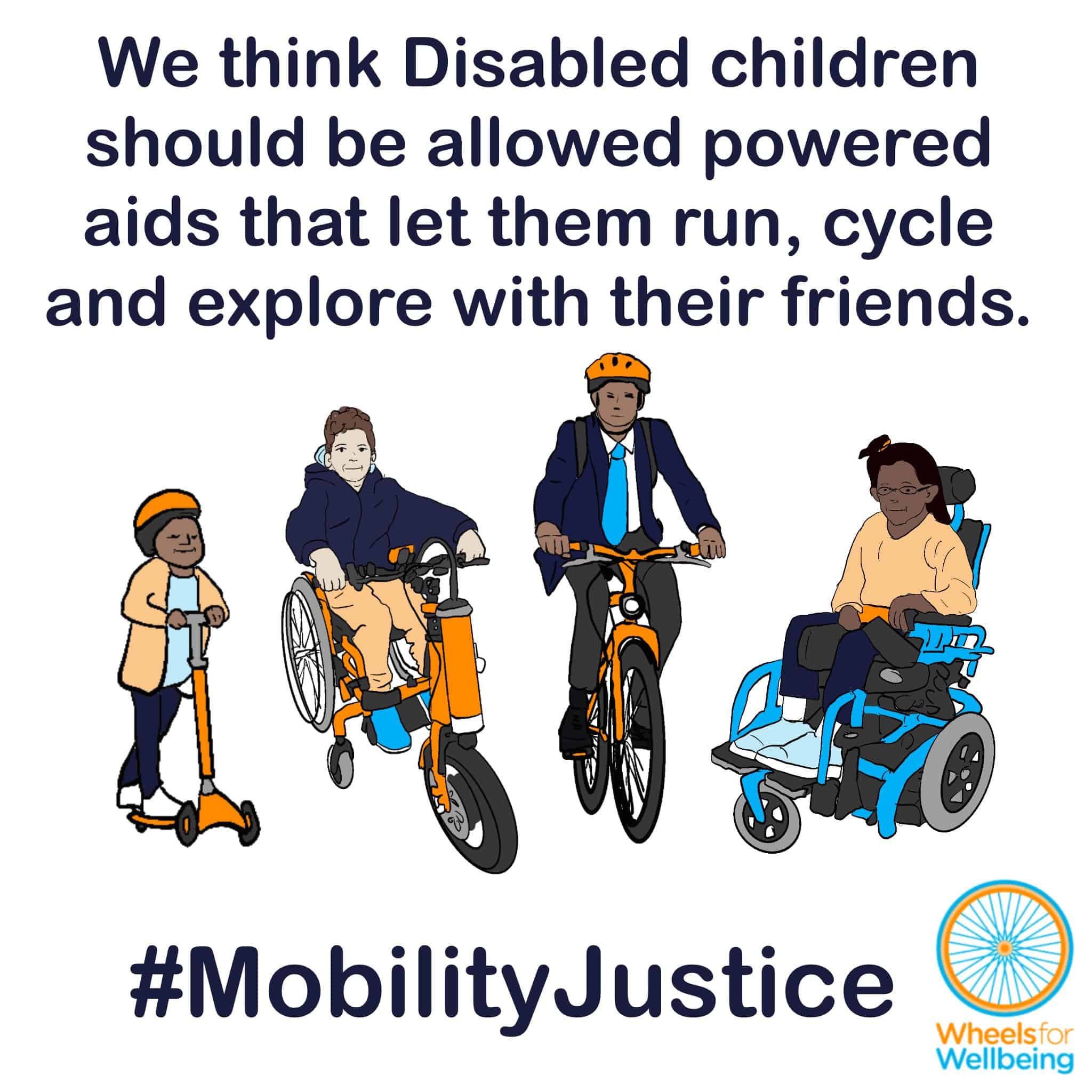
Why can’t Disabled children run or cycle with friends?
In the UK at present, laws about “invalid carriages” largely determine what mobility aids Disabled people can use. Children and young people aged under 14 are only allowed to use powered aids with a top speed of 4mph – a brisk walking speed.[i] That means children aged under 14 who need power to go above walking speed can’t keep up with friends who are running,[ii] scooting or cycling. We need the law to change, to allow Disabled children the same play, socialising, learning and independence options as their non-disabled friends.
10-year-old B told us how much difference being allowed an e-cycle would make to them:
I will be 11 this summer. I have achondroplasia – this means that I have dwarfism. I love to ride my bike, it is specially made so that someone with my condition can ride it. I have done all my bike abilities. I start secondary school in September and I really wanted to be able to ride my bike there and back on the cycle paths that go from near my home. The occupational therapist, the school and my family have said that this will be too tiring for me with all the busy day I will have a secondary school. I know they are right really because my body does get very tired and achy because of my condition. The best thing would have been if I could have an e-bike! It would have helped me just like a mobility aid. This would help me be independent and not have to go to school in a car. But, this can’t happen. I am not allowed to ride an e-bike and I cannot have one that is seen as a mobility aid. I really want this to change. I want the police and the government to know how important this is to me and people like me.”
And the age 14 limit for class 3 “invalid carriages” means 8-year-old Alfie is unable to get any chair that he’s legally allowed to use! Alfie’s dad Joe told Wheelchair Alliance last year:
Alfie will have a short life, so it needs to be his best life. Every minute needs to count.
When he passes his NHS power chair assessment, he will be offered a chair described as class 2 but, because of its higher rated batteries, it will be over the weight limit and therefore non-class. There are no suitable chairs that comply with the regs – he is a criminal in the eyes of the law.
And if we buy him a suitable off-road chair (one that will work on surfaces such as mud, sand and snow) it will be a class 3. However, he can’t drive a class 3 or non-class chair as he is only eight!
What legal changes do we need?
A small number of legal changes would make big differences to different accessible mobility options for a lot of different people. You may notice that this legal changes section is the same or similar in some of the other case studies in this series!
We want new mobility aid laws to be fit for purpose, fair and future-proofed.
- We think that children should be allowed to use powered mobility aids that go above 4mph, including class 3 “invalid carriages”/mobility devices, power attachments, e-scooters and comparable micromobility devices that are made legal for public spaces use in future, and e-cycles – if their parents/carers and they judge that they are competent to do so.
- We think that parents/carers should be held responsible for their children’s safety and responsible behaviour while a child is using powered mobility devices, just as parents already are in other areas, such as seatbelt laws and school attendance.
This isn’t radical – this would make rules for children who need powered mobility to go above walking speed the same as existing UK rules for children using standard bikes and kick scooters – and the same as existing e-bike rules for children across much of Europe! [iii]
- Non-disabled children are allowed to run and to use higher-speed pedaled or kick-powered devices like bikes, trikes and scooters. Many of these devices can go faster than the top speeds of 8mph for UK-legal class 3 “invalid carriages”, 12mph/20kph for many power attachments and top powered speed of 15.5mph for e-cycles.
- Children in much of Europe are already allowed to use e-bikes. [iv] We have been unable to find any reports of safety issues or collisions linked to children’s use of e-bikes in countries where this is legal.
- Technologies like collision avoidance and acceleration restrictors mean that heavier powered aids can be made safe for everyone to use, according to their needs.
What you can do
We want Disabled people to have the same journey-making choices as non-disabled people. For this to happen, we need the law to change. The Department for Transport is running a 15-week consultation into changing mobility aid laws. The consultation deadline is 22nd April 2026.
You can help make changes to improve mobility options for all Disabled people:
- Read our explainers and recommendations. These should all be released by mid February 2026. We are concerned about some of the consultation wording and a lack of information on current laws in the consultation document. Without our extra information, case studies and links to other sources, we’re worried people could accidentally give answers that will cause problems for themselves or others.
- Once you’ve read and considered our explainers and recommendations, please respond to the Department for Transport’s consultation.
The information in this sheet directly links to consultation questions 18 and 19, and could be used to support responses to questions 20-27 and 30.
We are releasing free resources about all areas of mobility aid regulations to cover all aspects of the consultation as quickly as we can. Resources include written information, case studies, graphics, social media and webinars.
Follow all our information updates and find out more about how changes to the law can improve mobility for Disabled people on Bluesky, LinkedIn, Instagram and Facebook.
Contact us with comments, questions and suggestions at info@wheelsforwellbeing.org.
Join our free peer-support campaigning forum for Disabled people and allies.
Sign up for our newsletter (bottom of page)
References
[i] British Heart Foundation walking and trekking FAQs: https://www.bhf.org.uk/how-you-can-help/events/walking-and-trekking-faqs
[ii] Casual running speeds for 5km runs from RunRepeat indicates typical long-distance speeds of around 10kph, 6mph https://www.countryfile.com/go-outdoors/get-active/whats-a-good-5k-time-parkrun. Fast long-distance running speeds are around double that, 20kph, 12mph. https://therunningchannel.com/fastest-and-slowest-parkruns-uk/ . Fast sprint speeds are up to 10m/s, 36kph, 22mph https://en.wikipedia.org/wiki/100_metres
[iii] In much of Europe, e-cycles are regulated exactly the same as unpowered cycles, so children are allowed to use e-cycles in many European countries. https://www.hetzwartefietsenplan.com/en/blog/news/age-electric-bicycle-in-europe and https://amplerbikes.com/en-GB/blog/electric-bike-age-limit – a number of other articles particularly from the USA appear to have confused the EAPC and speed pedelec categories regarding age limits for EAPCs in EU countries. Speed pedelecs typically have a higher minimum age for use and a driving license is often required to use them legally. In the UK, speed pedelecs are legally mopeds or motorbikes.
[iv] ibid
Please donate to support our work if you can
Wheels for Wellbeing is a small Disabled People’s Organisation – a charity run by and for Disabled people. We depend on donations for our campaigning work: very few grants are available for campaigning.
Any donation you can make helps us keep working to achieve mobility justice for all.
#MobilityJustice #EveryJourneyEveryone