
Download this explainer as a Word document
Download this explainer as a pdf
WfW are not legal experts and we do not provide legal advice This document is for information only and must not be regarded as legal advice. Readers are solely responsible for any use they make of this information.
What is “mental capacity” – and why does it matter for mobility?
When we say a person has mental capacity, we mean they are able to make decisions.
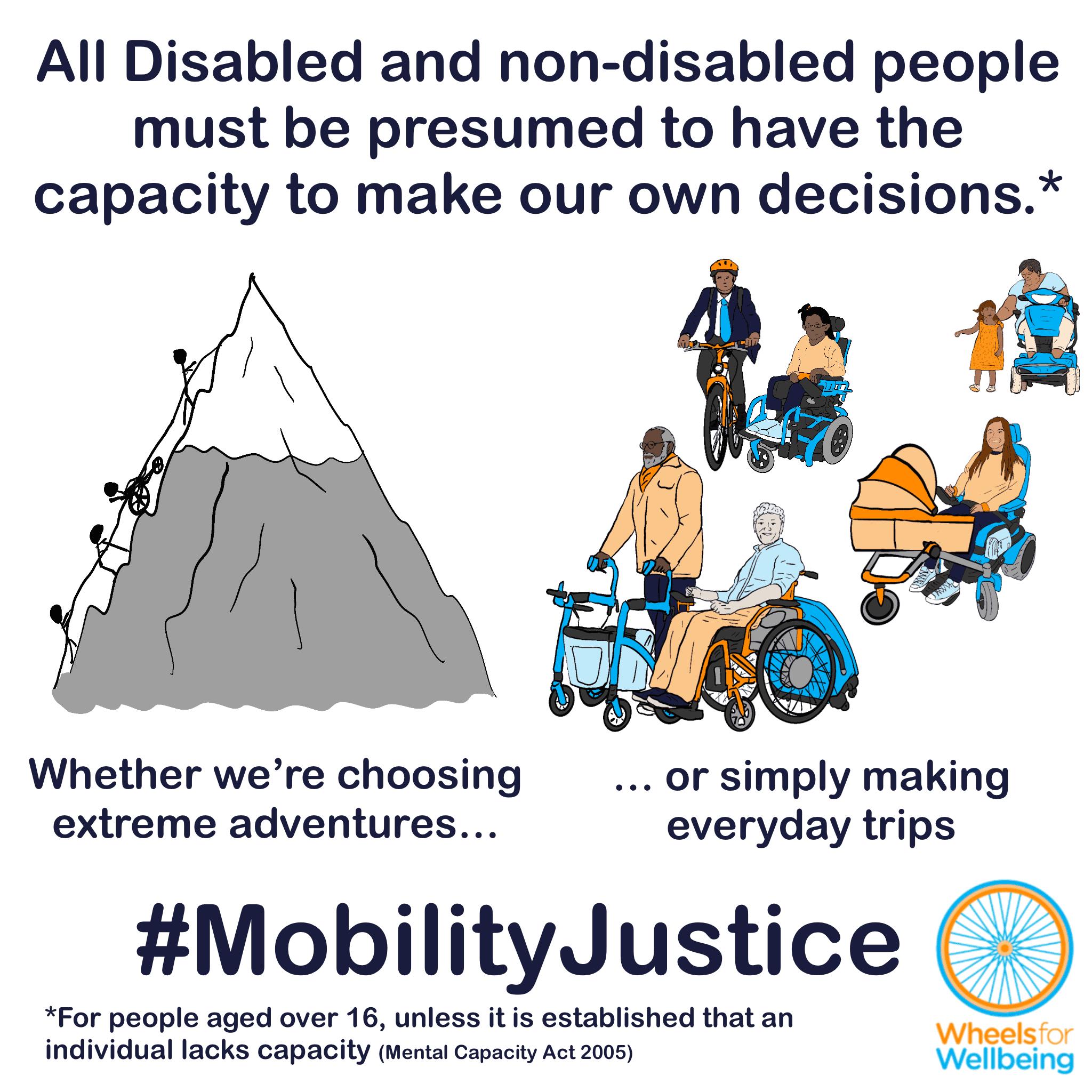
Under the Mental Capacity Act 2005, everyone over 16 has the capacity to make their own decisions unless they have been properly assessed as not having capacity.
In the context of the Mental Capacity Act we’re usually talking about decisions affecting a person’s own life (including a person’s dependents) – about care, health, relationships, money, mobility and travel, where we live, employment, education and more.
The Mental Capacity Act 2005[1] says:
S1(2) “A person must be assumed to have capacity unless it is established that he lacks capacity.”
S1(4) “A person is not to be treated as unable to make a decision merely because he makes an unwise decision.”
S3(1) “… a person is unable to make a decision for himself if he is unable—
(a)to understand the information relevant to the decision,
(b)to retain that information,
(c)to use or weigh that information as part of the process of making the decision, or
(d)to communicate his decision (whether by talking, using sign language or any other means).”
The Equality Act 2010 s20 and 21 requires all anticipatory reasonable adjustments to be made, including to regulations, to provide Disabled people with equal access. Failure to make reasonable adjustments is discrimination.[2]
The Public Sector Equality Duty of the Equality Act requires public bodies to “have due regard to the need to” eliminate discrimination, harassment and victimisation, and to advance equality of opportunity for Disabled people.[3]
Current mobility aid rules presume Disabled people lack capacity:
Disabled people and our families are routinely presumed to lack the capacity to make decisions that are directly comparable to decisions that non-disabled people (and parents of non-disabled children) are presumed to have the capacity to make. For example:
- Disabled people using powered mobility aids are restricted to a maximum powered speed of 8mph on roads. In contrast, largely non-disabled people using e-cycles and e-scooters comparable in size, function and stability to powered mobility aids including e-handcycles and e-trikes are allowed to travel at a maximum powered speed of 15.5mph (and faster by pedalling or rolling downhill). Further, the 8mph legal maximum powered speed applies to devices which are already safety certified under British Standards[4] to 20kph, 12.4mph. Safety is demonstrably not the reason for the 8mph speed restriction.
- Disabled people using powered mobility aids in pedestrian spaces are restricted by law to a maximum speed of 4mph. In contrast, non-disabled people moving in comparable ways have no legal restriction preventing them from moving at above 4mph on pavements. This includes people running downhill, pushing or pulling handcarts, trolleys, pushchairs and sack barrows with comparable mass to many powered mobility aids and often with no braking systems. Mobility aid users are already trusted to slow to safe speeds well below 4mph in busy or hazardous spaces such as shopping centres, narrow footways etc. As above, we have found no evidence that Disabled people using mobility aids pose a greater risk to ourselves or others than non-disabled people with comparable masses and speeds, and therefore can find no justification for imposing legal speed restrictions on Disabled people that do not apply to comparable non-disabled people.
- Disabled people are presently prohibited from carrying our children and adult dependents on our “invalid carriage” mobility devices, and from using person- or cargo- carrying attachments with our mobility aids. In contrast, people walking/running are permitted to carry others in any way they deem appropriate, including with no special equipment (in arms, piggy backs or on shoulders), or using child carriers, pushchairs, wheelchairs and handcarts. People cycling, who are stereotypically expected to be non-disabled, are permitted to carry any number of children, adults or cargo on or attached to our cycles, provided the cycle is designed or adapted to transport the people it is carrying.[5]
- Parents of Disabled children who need power to assist with movement are not permitted to provide our children with devices which enable above-walking-speed movement until our children are 14, whatever our judgement about our child’s capability. In contrast, parents of non-disabled children are encouraged to support our children to develop the ability to run, scoot and cycle trips including at above 4mph, to improve physical and emotional health, social development and independence.[6] [7]
We believe that the above examples demonstrate illegal discrimination, breaching both the Mental Capacity Act 2005 and the Equality Act 2010.
Regulations around mobility aid use in public spaces interact with restrictions on provision of aids by organisations like the NHS and a lack of information about modern powered aid function options. This family contacted us about their struggle to get their child a powerchair which would allow them to experience moving independently:
“When you take a child for assessment for a powerchair, they will only be allowed one if they can already control it and do so safely. Isn’t that similar to telling a child they can’t have a bike until they can ride one or walk until they understand road safety….
My son may never be able to steer a chair well enough to use it on pavements but would benefit so much from being able to use one in parks, hallways and gardens. Of course we’ll never know whether the former is possible until he’s given the opportunity to practice.”
We were able to share examples of powerchairs which have collision avoidance,[8] line following[9] and autonomous movement[10] functions with this family. These technologies can enable people who initially or permanently have difficulty fully controlling a device without such assistance to remain safe and avoid collisions while using a powered aid.
What legal changes do we need?
We need new mobility aid laws which meet the requirements of the Equality Act 2010 and the Mental Capacity Act 2005, as well as the requirements of the ECHR and UNCRPD.
We want new mobility aid laws to be fit for purpose, fair and future-proofed.
- Mobility aid laws must provide Disabled people with equal rights to pedestrian-equivalent and cycling or cycling-equivalent mobility compared to non-disabled people, including rights for Disabled people of all ages to equivalent speed and equivalent passenger and cargo-carrying options compared to non-disabled peers.
- Regulations prohibiting dangerous and antisocial behaviour by all public space users apply equally to mobility aid users. Disabled people can and should face the same civil or criminal enforcement against dangerous and antisocial acts that non-disabled people engaging in the same or comparable acts would face.
- Where it is suspected that an individual lacks capacity to make some or all decisions, their capacity must be properly assessed under the Mental Capacity Act, and their decisions, including for mobility, must be supported as determined by appropriately appointed people, such as family members or suitable professionals.
This isn’t radical – we just want the rules for people using mobility aids to presume that Disabled people as well as non-disabled people have the capacity to make our own decisions, as the law requires.
- The Equality Act 2010 requires the government to make all reasonable adjustments to regulations to provide Disabled people with mobility equality[11] – and says these adjustments must be made before any Disabled people experience discrimination.
- The Mental Capacity Act 2005 says that everyone must be assumed to have the capacity to make decisions.[12] That means it’s not reasonable to apply blanket requirements and restrictions to devices intended for Disabled people’s use that don’t apply to comparable devices mostly intended for non-disabled people’s use, as this implicitly assumes that Disabled people cannot be trusted to make safe decisions in the same way that non-disabled people can.
- Many non-disabled and some Disabled people already use a full range of e-assist cycles at up to 15.5mph powered speeds in all cycle-permitted spaces.
- Some Disabled people already use fully powered mobility aids that are certified under existing British Standards for safe use fully powered up to 12.4mph (20kph) – but still must legally have these devices restricted to 8mph maximum for the device to be legal for use in public spaces.
- Disabled people already use judgement to select appropriate speeds and to choose the best available ways to make trips with the people and luggage we need to. Current mobility aid legal restrictions are making Disabled people’s journeys more difficult, slower and often less safe than equivalent non-disabled people’s journeys.
What you can do
We want Disabled people to have the same journey-making choices as non-disabled people. For this to happen, we need the law to change. The Department for Transport is running a consultation into changing mobility aid laws. The consultation deadline is 22nd April 2026.
You can help make changes to improve mobility options for all Disabled people:
- Read our explainers and recommendations. We are concerned about some of the consultation wording and a lack of information on current laws in the consultation document. Without our extra information, case studies and links to other sources, we’re worried people could accidentally give answers that will cause problems for themselves or others.
- Once you’ve read and considered our explainers and recommendations, please respond to the Department for Transport’s consultation.
The information in this sheet directly links to consultation questions 20, 21 and 22, and indirectly to a range of other questions, including 10-13.
We are releasing free resources about all areas of mobility aid regulations to cover all aspects of the consultation as quickly as we can. Resources include written information, case studies, graphics, social media and webinars.
Follow all our information updates and find out more about how changes to the law can improve mobility for Disabled people @WheelsForWellbeing on Bluesky, LinkedIn, Instagram and Facebook.
Contact us with comments, questions and suggestions at info@wheelsforwellbeing.org.
Join our free peer-support campaigning forum for Disabled people and allies.
Sign up for our newsletter (bottom of page)
Please donate to support our work if you can:
Wheels for Wellbeing is a small Disabled People’s Organisation – a charity run by and for Disabled people. We depend on donations for our campaigning work: very few grants are available for campaigning.
Any donation you can make helps us keep working to achieve mobility justice for all.
#MobilityJustice #EveryJourneyEveryone
[1] Mental Capacity Act 2005 https://www.legislation.gov.uk/ukpga/2005/9/contents
[2] Wheels for Wellbeing Quick Guide to the Equality Act 2010 https://wheelsforwellbeing.org.uk/wheels-for-wellbeing-quick-guide-to-the-equality-act-2010/
[3] Wheels for Wellbeing Quick Guide to the Public Sector Equality Duty https://wheelsforwellbeing.org.uk/wheels-for-wellbeing-quick-guide-to-the-public-sector-equality-duty/
[4] BS EN 12184:2022 Electrically powered wheelchair, scooters and their chargers. Requirements and test methods https://knowledge.bsigroup.com/products/electrically-powered-wheelchairs-scooters-and-their-chargers-requirements-and-test-methods
[5] See Wheels for Wellbeing my mobility device information and sources spreadsheet for further references and explanations: https://wheelsforwellbeing.org.uk/wp-content/uploads/2026/02/My-Mobility-device-information-and-sources-v06.xlsx
[6] In 2025, the government announced £30M funding for “Bikeability” training for children, and £8.5M for organisations to promote “walking, wheeling and cycling initiatives in schools and communities” https://www.gov.uk/government/news/almost-300-million-to-gear-up-new-walking-wheeling-and-cycling-schemes
[7] Events promoting above-walking-speed mobility for children that are supported by government funding (reference above) include Walk Wheel Cycle Trust’s “Big Walk and Wheel” promoting “walking, wheeling, scooting and cycling to school” https://bigwalkandwheel.org.uk/ and Bikeability’s “Cycle to School Week” https://www.bikeability.org.uk/cycletoschoolweek/
[8] E.g. Luci system: https://luci.com/
[9] Smile Smart System powerchairs: https://www.smilesmart-tech.com/product/smilesmartsystem-powerchairs/
[10] Thiis.co.uk 2026 “best of innovation winner defines a new category of smart mobility vehicle” https://thiis.co.uk/ces-2026-best-of-innovation-winner-defines-a-new-category-of-smart-mobility-vehicle/
[11] Wheels for Wellbeing Quick Guide to the Equality Act 2010 https://wheelsforwellbeing.org.uk/wheels-for-wellbeing-quick-guide-to-the-equality-act-2010/
[12] Mental Capacity Act 2005 https://www.legislation.gov.uk/ukpga/2005/9/contents