Download this guide as a Word document
1 Wheels for Wellbeing’s Position
Wheels for Wellbeing use the Social Model of disability combined with a Disability Justice approach for all our work, including provision of cycling sessions, consultancy and campaigning for improvements to regulations, policies, practices and provisions affecting Disabled people in cycling, active travel and multi-modal mobility.
2 What is the Social Model of disability?
The Social Model of disability says that Disabled people are disabled by barriers in society, not by our impairments or differences.
“Disability results from the interaction between persons with impairments and attitudinal and environmental barriers that hinder their full and effective participation in society on an equal basis with others.”[1]
The Social Model of disability was developed by Disabled people in the second half of the 20th century as part of the Disability Rights Movement. It was based on the lived experience of Disabled people and challenged the medical model of disability. The medical model defines disability as a deficit which needs to be cured or overcome in order for Disabled people to live full and equal lives. Instead of focusing on fixing individuals, the Social Model focuses on removing barriers to participation and demanding equal rights. This makes it very effective at supporting work to remove real-world barriers and to prevent new barriers in active and sustainable transport.
The United Nations Convention on the Rights of Persons with Disabilities (UNCRPD) was developed using the Social Model of disability and a rights-based approach. The UNCRPD explicitly rejects the medical model of disability[2]. The Equality Act 2010 requires removal of societal access barriers and promotion of equality of access. A Social Model approach is the best way for public organisations and service providers to meet the requirements of the Equality Act.
Barriers in society include (from Disability Rights UK Social Model resource):
- Physical barriers
- Attitudinal barriers
- Communication barriers
- Institutional and organisational barriers
- Discrimination
- Economic barriers
For example:
-
A mobility impaired person uses a wheelchair to get to work, shops and look after their children. They cannot make necessary trips when dropped kerbs are missing, badly made or blocked. Physical barriers are causing their disability.
-
A visually impaired person and their dyslexic friend both use phones to read written documents out loud. When information is provided only in formats that their assistive software cannot read, they cannot read essential documents for healthcare, education and work. Communication (and institutional) barriers are causing their disability.
-
A person with a visible physical difference who lives alone has been repeatedly abused in public spaces. They risk assess that they cannot safely go out alone, rendering them largely housebound. Discrimination and attitudinal barriers are causing their disability.
Like all models, the Social Model of disability has limitations. The Social Model does not adequately account for intersectional factors or that for many Disabled people, removing accessibility barriers alone will not enable their equal participation. For example, gender equality is also needed. Another potential limitation is that in some interpretations, the Social Model does not allow for the ongoing relevance of impairments in many Disabled people’s lives[3]: many Disabled people continue to experience disability, for example from pain, no matter how accessible the environment they are in. Other Disabled people do not like the term “impairment” as it is originally a medical term and has similar meanings to deficit. This is particularly true for people who experience mental distress or who are neurodivergent and who do not wish to be referred to as mentally impaired.
3 What is Disability Justice?
Disability Justice is a rights-based framework first described by Sins Invalid in 2005.
Disability Justice requires inclusion of intersectionality. It is based on the premise that the most marginalised people’s perspectives and needs must be prioritised, and recognises that Disabled people with different marginalised and protected characteristics have different experiences.
Disability Justice includes very diverse experiences. It describes and supports approaches to improve accessibility to all areas of life for all Disabled people.
For example:
A Black, gay, Disabled man living in poverty in a rural area is likely to have a very different life from a wealthy, white, straight Disabled woman living in an urban area, even if both have the same impairments or differences.
Mobility Justice is another element of an intersectional, social justice approach that overlaps with Disability Justice. Both are important for improving mobility for all minoritised and marginalised people. Mobility Justice is “the practice of targeting resources to create or improve journey-making options for those who currently have the least access to transport and mobility”.
Disability Justice and Mobility Justice frameworks enable decision-makers to take an equity-based approach and prioritise policy and design factors that tackle existing inequalities and are important to minoritised people, for example, social and environmental safety requirements that enable more people to use public spaces schemes.
Sometimes complete removal of a barrier might not be possible, for example where there are access frictions[4] such that all existing ways to remove a barrier for one group of people create or worsen barriers for another group. In these situations, a Disability Justice approach helps work out how to search for new solutions and minimise the barrier in a way that is fairest to everyone.
The Social Model of disability with a Disability Justice approach is usually the simplest and most effective framing that can ensure equal rights and equitable access for Disabled people in regulations, policies, provision and practices.
4 The Social Model in practice: Removing barriers to access
Barriers intended to exclude motorcycles from a National Cycle Network route in Cheshire prevented people using non-standard cycles, people who couldn’t lift their bicycle, and people using many types of other mobility aids from using the route.

Photo caption: Before: inaccessible barriers After: inclusive access (photo credit: Congleton Sustainable Travel)
The local authority and Walk Wheel Cycle Trust reassessed the barriers, taking a Social Model approach. To provide Disabled people with equitable access to the route, the restrictive barriers were removed and replaced with two-way gaps a minimum of 1.5m wide and a single bollard to prevent car and van access to the traffic-free route.
With the barriers removed, many more Disabled and non-disabled people are able to use the path safely, benefitting everyone.
Walk Wheel Cycle Trust work monitoring barrier removals in York found that after 30 barriers were removed from the Foss Islands path, not only was access improved in line with the Social Model and Disability Justice, for every 1 motorcyclist who used the traffic-free routes, over 22,000 people walking/wheeling and cycling used the routes.
5 Summary
- The Social Model of disability enables work to improve accessibility in all areas of regulation, policy and service provision, including for public spaces, active travel and public transport.
- Disability Justice framing helps to ensure that the different access barriers that may be faced by different people with intersectionally minoritised characteristics are taken into account. Minoritised characteristics include disability, sex, ethnicity, LGBTQIA+ status, religion, age, gender, socioeconomic status, educational status, immigration status, carer status, health status and more.
- Many different models can be used to describe disability. Some of these models promote discrimination against Disabled people and must not be used, including the Medical and Charity models of disability. Other models, such as the Human Rights model, also promote Disabled people’s rights and access, but are more complex than the Social Model. They are useful in situations where extra complexity including consideration of individual factors is relevant.
6 Appendix: Some other models of disability
- Human rights model: “The human rights model focuses on the inherent dignity of the human being and subsequently, but only if necessary, on the person’s medical characteristics. It places the individual centre stage in all decisions affecting [them] and, most importantly, locates the main ‘problem’ outside the person and in society”[5]. The human rights model is a more complex rights-based framework centred on disability law and policy rather than on disability itself. The human rights model and Social Model are compatible with and complement each other.
- Medical model: Disabilities are “defects” within an individual which should be treated and cured – any “problem” is within an individual. In this model, society does not have a role in removing barriers to equality of access and inclusion for Disabled people, except perhaps through the provision of healthcare and charitable support. The medical model and the charity model below have historic roots that developed through industrialisation, and were closely linked with the eugenic movement. The teams developing the UNCRPD explicitly rejected the medical model of disability (see section 2).
- Charity model: An element of or consequence of the medical model. In the charity model, Disabled people are not considered equal members of society. Instead, we are largely tragic, pitiable figures, who passively receive support from heroic, generous non-disabled people. The charity model encourages ideas of “deserving” and “undeserving” Disabled people, and inspiration porn.
- Biopsychosocial model: Developed by doctors in the mid-20th century to expand the medial model of health, illness and disability, the “bio” element covers a person’s medical conditions, the “psycho” component covers a person’s mental state and beliefs, and the “social” component covers a person’s environment.
The biopsychosocial model prioritises the medical model of disability and explicitly medicalises all impairments and differences: the biopsychosocial model definition of disability used in WHO ICF requires that disability can only exist if associated with health conditions, conflating disability with illness and implying need for medical intervention or “cure”. This is highly problematic: People with many impairments or differences associated with disability are in good health and will not benefit from any medical diagnoses or treatments. All testing, diagnoses and treatments can cause harm[6]. The biopsychosocial model effectively requires that all Disabled people are professionally judged to be “ill” or “defective” before they are eligible to ask for removal of societal access barriers they face, for any difference or impairment from Deafness to limb difference to dyslexia. At the same time, the “psychological” element of the model promotes the idea that barriers Disabled people face are, or can be, due to having internal psychological barriers i.e. a “bad attitude”, or “not trying hard enough”.
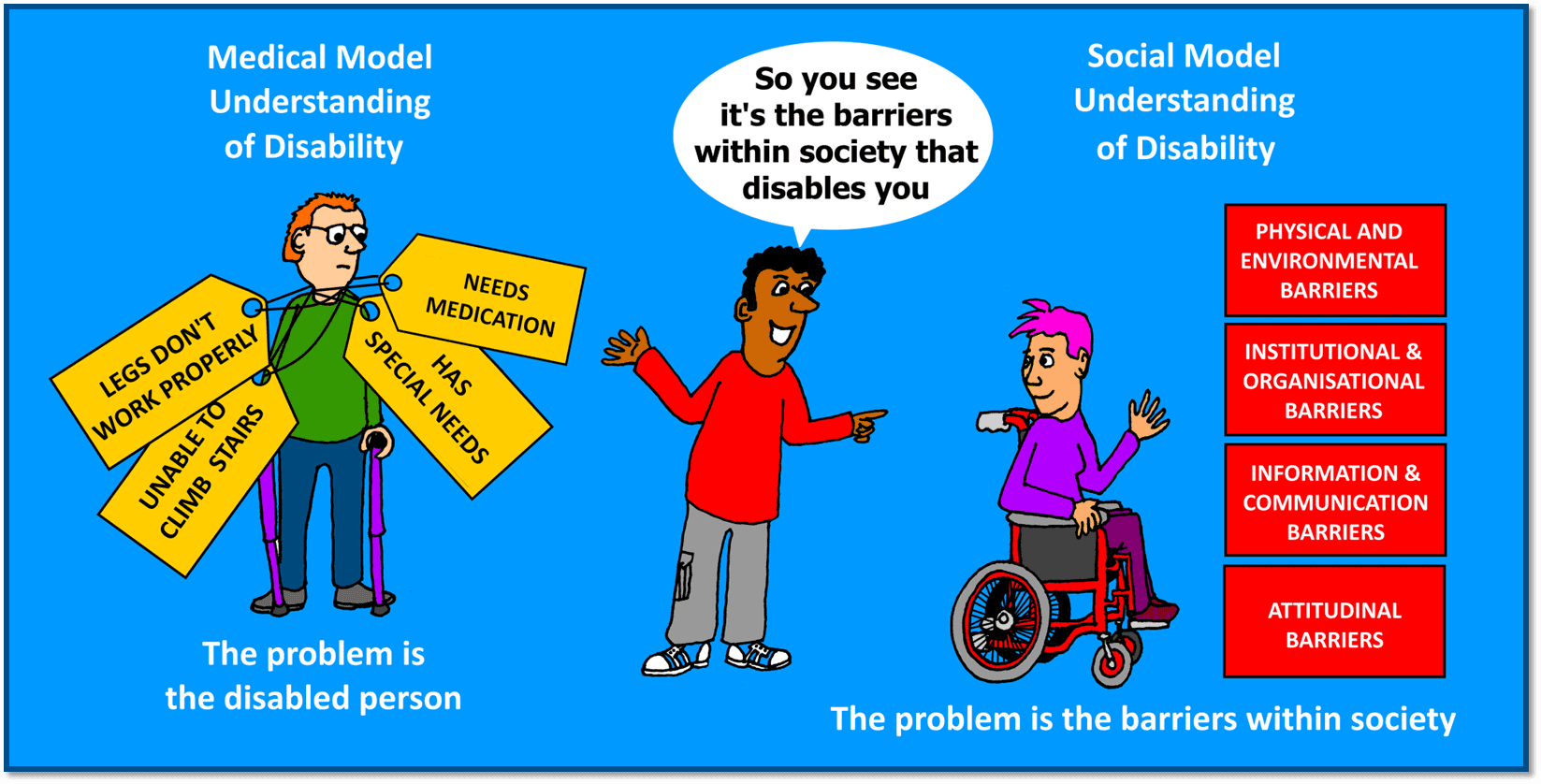
Image caption: Medical Model vs Social Model – credit Crippen
References
[1] See United Nations Convention on the Rights of Persons with Disabilities (UNCRPD) preamble paragraph (e) “Recognizing that disability is an evolving concept and that disability results from the interaction between persons with impairments and attitudinal and environmental barriers that hinders their full and effective participation in society on an equal basis with others” and International Classification of Functioning, Disability and Health (ICF) definitions. Please note: defining disability as identical to reduction in or restriction of function and the ICF neutral classifications of function are compatible with the Social Model of disability, but many other aspects of the ICF approach including the ICF requirement that disability must always be associated with a health condition align with the medical model and are not compatible with the Social Model.
[2] Lawson, A., & Beckett, A. E. (2021). The social and human rights models of disability: towards a complementarity thesis. The International Journal of Human Rights, 25(2), 348–379. https://doi.org/10.1080/13642987.2020.1783533
[3] E.g. Tom Shakespeare (2010) “The Social Model of Disability” http://thedigitalcommons.org/docs/shakespeare_social-model-of-disability.pdf vs Lawson, A., & Beckett, A. E. (2021). The social and human rights models of disability: towards a complementarity thesis. The International Journal of Human Rights, 25(2), 348–379. https://doi.org/10.1080/13642987.2020.1783533
[4] Larrington-Spencer, H. (2024), Disabled people’s access needs in transport decarbonisation. IPPR Progressive Review, 31: 243-249. https://doi.org/10.1111/newe.12414
[5] “G. Quinn and T. Degener, ‘The Moral Authority for Change: Human Rights Values and the World Wide Process of Disability Reform’, in Human Rights and Disability: The Current Use and Future Potential of Human Rights Instruments in the Context of Disability, eds. G. Quinn and T. Degener (United Nations, 2002), 13, 14.” Taken from Lawson, A., & Beckett, A. E. (2021). The social and human rights models of disability: towards a complementarity thesis. The International Journal of Human Rights, 25(2), 348–379. https://doi.org/10.1080/13642987.2020.1783533
[6] E.g. Krishnan NR, Kasthuri AS. Iatrogenic Disorders. Med J Armed Forces India. 2005 Jan;61(1):2-6. doi: 10.1016/S0377-1237(05)80107-8. Epub 2011 Jul 21. PMID: 27407693; PMCID: PMC4923397. , Boisvert CM, Faust D. Iatrogenic symptoms in psychotherapy. A theoretical exploration of the potential impact of labels, language, and belief systems. Am J Psychother. 2002;56(2):244-59. doi: 10.1176/appi.psychotherapy.2002.56.2.244. PMID: 12125301.