
These slides were produced at the request of Activate Cycle Academy for use in courses training police forces to correctly identify illegal e-cycles and other illegal e-powered devices which are eligible for seizure under Road Traffic Act 1988 s165A.
Individuals and organisations are welcome to use these slides to support education and advocacy around inclusive e-mobility use, with attribution to Wheels for Wellbeing. Please do not alter these slides without written consent from Wheels for Wellbeing.
Identifying mobility aids for police training v02 pdf format
Identifying mobility aids for police training v02 pptx format
Slide contents is as follows:
Slide 1: Recognising Mobility Aids
- Many Disabled people use mobility aids for essential movement indoors and outdoors.
- Different Disabled people use different mobility aids for different purposes. All the pictures below show Disabled people using mobility aids
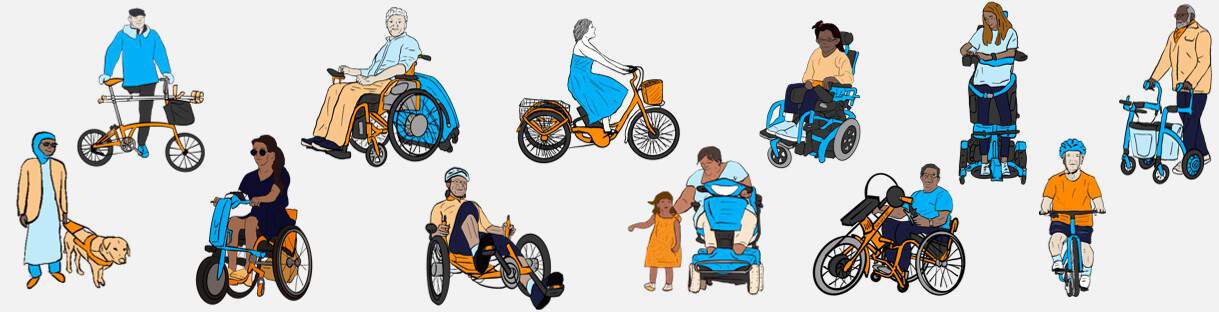
Slide 2: Do not seize or remove Disabled people’s mobility aids
Wheels for Wellbeing recommend: Never seize or remove a Disabled person’s mobility aid, except when essential for safety, such as in situations where you would physically restrain a non-disabled person and for emergency assistance
- Ride-on mobility aids that aren’t cycles or EAPCs are regulated as “invalid carriages”. Different laws have different definitions of “invalid carriages”.
- In the Road Traffic Act 1988, an “invalid carriage” is any vehicle made for a Disabled person with unladen weight 254kg or less.
- “Invalid carriages” may not be seized under RTA1988 s165A.

Disclaimer:
Wheels for Wellbeing are a Disabled People’s Organisation and registered charity number 112095 working to improve Disabled people’s access to mobility. We provide expert training and consultancy services. We are not lawyers and do not provide legal advice.
See https://wheelsforwellbeing.org.uk/our-campaigns/ for more information, including a huge range of free downloadable resources.