
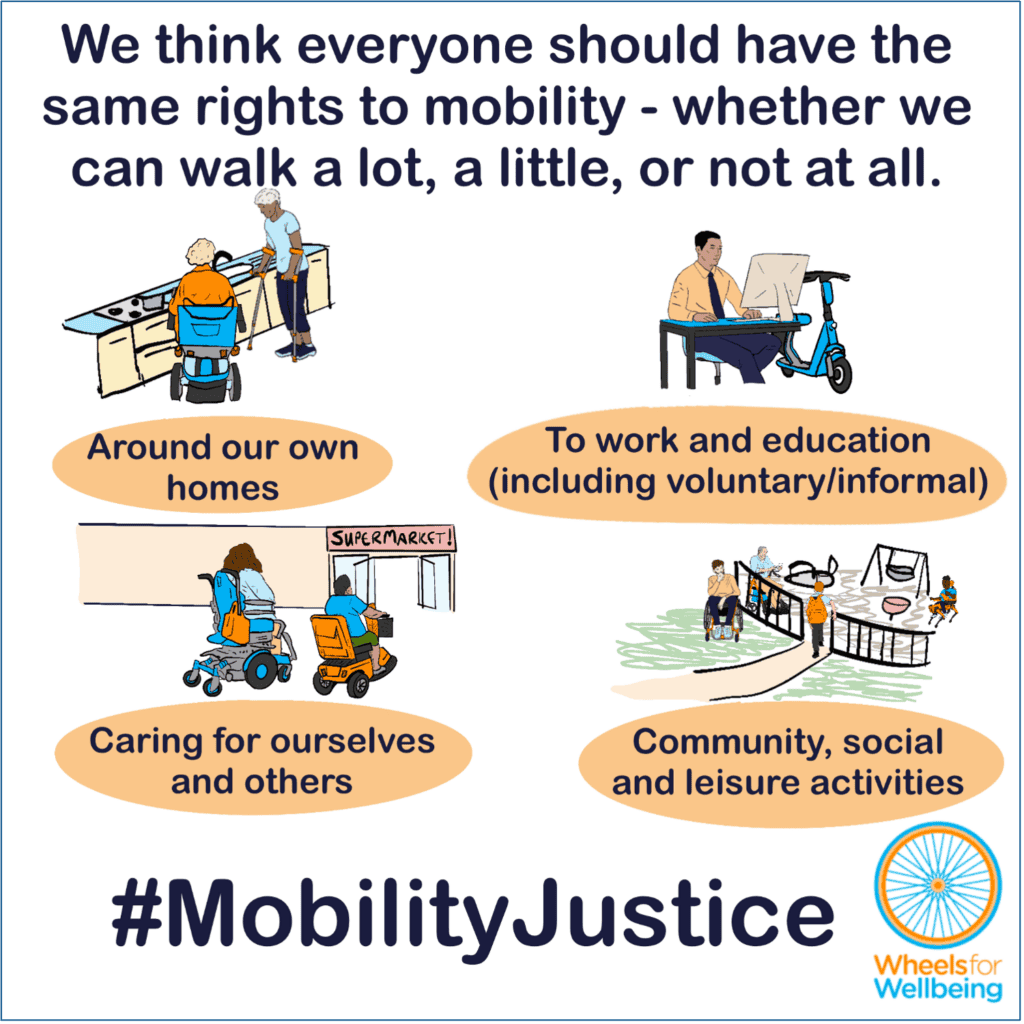
What access rights do Disabled people using mobility aids have now?
The Equality Act 2010[1] says that the government are required to make all reasonable adjustments to achieve equality of access for Disabled people. This is an anticipatory duty – it must be done before anyone experiences discrimination, and it affects rules, policies and practices as well as physical access measures. The government are also required to have due regard to the need to advance equality of opportunity for Disabled people.[2]
The UK is also a signatory to the United Nations Declaration on the Rights of Persons with Disabilities (UNCRPD).
From UNCRPD article 20, personal mobility[3]
“States Parties shall take effective measures to ensure personal mobility with the greatest possible independence for persons with disabilities, including by:
- a) Facilitating the personal mobility of persons with disabilities in the manner and at the time of their choice, and at affordable cost;
- b) Facilitating access by persons with disabilities to quality mobility aids, devices, assistive technologies and forms of live assistance and intermediaries, including by making them available at affordable cost;”
Our equalities laws and obligations seem to say that Disabled people should have the right to make all the trips that we need to, using the mobility aids that work best for us – from assistance dogs to canes, crutches to cycles and rollators to wheelchairs.
But that is not what happens in practice.
There are probably at least 7.5 million Disabled people in the UK today who do not have mobility aids suitable for making local trips, including travelling short distances to public transport and local services.[4]
There are lots of reasons behind this figure, many of which are connected with our outdated and discriminatory “invalid carriages” laws:[5]
- Lack of legal recognition for devices such as cycles, all-terrain wheelchairs and micromobility devices as mobility aids;
- Inadequate design and function of many devices that are legally recognised as aids;
- Lack of access to appropriate medical care and assessments;
- Inadequate aids or no aids being provided to Disabled people by services such as NHS wheelchair services, with a “postcode lottery” of expertise, provision and refusal of aids around the country;[6]
- Wheelchair and other aid provision criteria not having been created to meet people’s real-life needs in ways comparable to requirements for other NHS services – for example, assessment of benefit from glasses[7], provision of hearing aids[8] or funding for surgical and medical measures that can provide comparable improvement mobility to mobility aid provision[9];
- Lack of accessibility and insufficient provision of access modifications for people’s homes and surrounding areas;
- Inadequate maintenance and repair provision for mobility aids, homes and the wider environment;
- Risk of stigma and harassment/abuse deterring people from using mobility aids, and more.[10]
This means that only a minority of Disabled people in the UK have any mobility aid that meets our needs, and an even smaller minority have a clinically prescribed mobility aid that meets our needs.
Worryingly, the first suggested objective in the current government mobility aids consultation is that some mobility aid use and access rights should be restricted to only Disabled people who have been professionally assessed as having “clinical need” for the mobility aid they are using. This approach is firmly embedded in the Medical Model of disability, [11]where professionals decide what Disabled people need and what we should be permitted to do, rather than the Social Model of disability[12] in which barriers to Disabled people’s access to society are recognised as the primary cause of disability and Disabled people are provided with agency and decision-making control over our own lives – and that the UK government states is its guiding ethos:[13]
Restricting Disabled people’s mobility based on “clinical need” assessments would breach the requirements of the Equality Act 2010 and UNCRPD article 20.
If Disabled people’s legal rights to mobility were restricted only to Disabled people who have been professionally assessed as needing prescribed mobility aids, or having “clinical need” for a specific aid, millions of Disabled people in the UK would be excluded by law from moving around our own homes and communities.
Excluding Disabled people is discrimination.
It is discriminatory to exclude any Disabled people from any activities that non-disabled people might typically expect to be able to do, unless it can be shown that it is impossible to make reasonable adjustments to include that Disabled person.
The graphic on the next page shows a range of different mobility and trip types which people typically expect themselves or others to be able to carry out as a part of everyday life and participation in society. A table containing the same information as the graphic is available in the endnotes of this explainer document.[14]
Many Disabled people with mobility-related impairments may need mobility aids to carry out any of the typical activities shown in the graphic, and especially to carry out these activities without severe pain, risk to health and within the same sort of timeframe that a non-disabled person would expect to carry them out.[15] Some Disabled people may need mobility aids only to carry out some of the activities – for example, a person may be able to get around their house without an aid, but need an aid for any movement outdoors, especially in windy or wet/icy weather. Few people with mobility-related impairments would be able to complete all these activities without a mobility aid – and fewer still would be predictably able to complete the activities without suitable mobility aids.
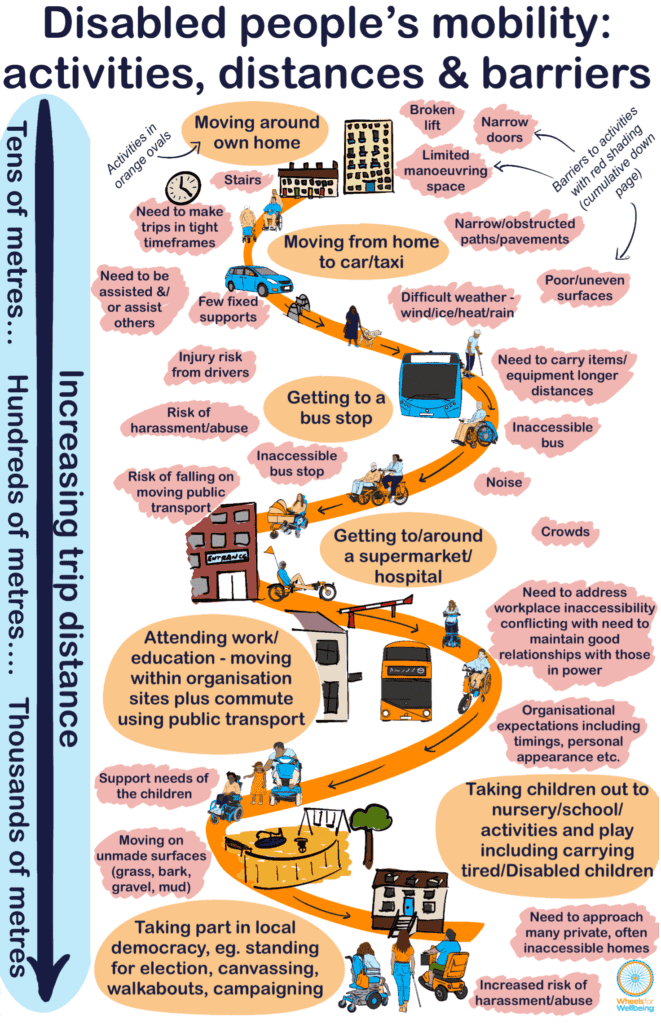
Gateway benefits such as PIP, and access to NHS and social care support such as prescribed aids and home adaptations, are typically only available to people assessed as unable to complete the top two activities without a wheelchair – “moving around own home” and “moving from home to car outside”, but even then, there remains a postcode lottery of provision.[16] [17]
If a Disabled person can manage to get around our own home and to a car outside using aids such as canes, crutches and rollators, even if only slowly, to a limited extent and with severe pain, we may well not be found eligible for formal support.
Even when it is provided, formal support is frequently inadequate. For example, many NHS providers will provide as default manual wheelchairs too heavy and badly-made for a user to self-propel, rather than a powered chair which could provide independent mobility.[18] Typically, better aids such as active manual wheelchairs and highly functional powerchairs or power attachments either will not be provided at all, or only a small amount of support funding will be provided, excluding people from aids unless they can find thousands of pounds of private or charitable funding. Aids such as active manual wheelchairs and powerchairs generally will not be provided to anyone who cannot prove they are already able to use them competently. This requirement rather like requiring a person to be already able to ride a bike before letting them learn to ride a bike.
Increasing the problem further, if a person is judged to need a mobility aid, many wheelchair service providers will not provide any mobility aid until the Disabled person is living in a home which has been assessed by the service as accessible. But many social care providers will not adapt a home unless a person has a mobility aid which requires those adaptations to be in place. This means many Disabled people, especially those living in rented accommodation, at risk of injury and isolation due to the inaccessibility of their property and lack of suitable mobility aids, often for months or years.
People most likely to be excluded from mobility access include:
- Disabled people who are waiting for assessment and Disabled people who are unable to gain assessment or professional recognition of mobility-related needs –even when our actual unaided mobility levels meet the criteria for support.
- Disabled people whose mobility levels fall outside the assessment criteria for support.
- Disabled people who live in inaccessible homes.
These groups are all more likely to be socioeconomically deprived and have multiple protected characteristics – for example, to also have multiple impairments particularly learning disabilities, be women, older or younger, racially minoritised, LGBTQIA+, etc.
And it’s worse than that.
Restricting access to mobility aids harms even the people who are able to access aids. For example, limiting provision will reduce apparent demand, innovation and economies of scale, inevitably reducing diversity and function of available aids while increasing cost and decreasing availability of services like maintenance, breakdown rescue and repair.
But we can solve the problem.
Ensuring that all people who decide we may benefit from using mobility aids have the right to use and support to access the aids we need will increase the market for aids, improving aid diversity, quality and function. Important elements include improved provision of devices which support active mobility, such as e-assist and detachable devices, and those which enable more people to enjoy independent supported mobility with functions such as collision avoidance and autonomous route following. More maintenance, breakdown rescue and repair services will become available locally for more people, and stigma around mobility aid use will be reduced, reducing probability of hostile challenges, harassment and abuse. Spaces will become more accessible as the need for access becomes more visible to designers and decision-makers. This is exactly parallel to what has happened with provision of glasses, and what is happening with provision of hearing aids and technological access options such as speech-to-text and text-to-speech software. It’s also what is happening with unrestricted mobility aids, particularly rollators.
Everyone benefits from derestricted access to mobility aids and recognition of diverse devices as mobility aids, when used to assist with or replace pedestrian mobility – including Disabled people with the least unaided mobility and those Disabled people who have been able to gain an adequate clinical prescription.
What legal changes do we need?
We need new mobility aid laws which meet the requirements of the Equality Act 2010 and the Mental Capacity Act 2005, as well as the requirements of the ECHR and UNCRPD. This requires new regulations to align with the Social Model of Disability.
We want new mobility aid laws to be fit for purpose, fair and future-proofed.
- Mobility aid laws must provide Disabled people with equal rights to pedestrian-equivalent and cycling or cycling-equivalent mobility compared to non-disabled people, including rights for Disabled people of all ages to equivalent speed and equivalent passenger and cargo-carrying options compared to non-disabled peers.
- Rights of access to public and private spaces using mobility aids and rights to use mobility aids at pedestrian speeds in pedestrian spaces and cycling speeds in cycling spaces must not be contingent on formal or clinical assessments or “proof” of disability. There must be no regulations that encourage public challenges or demands for Disabled people’s personal information to enable third parties to judge our “need” to use aids.
- Regulations prohibiting dangerous and antisocial behaviour by all public space users apply equally to mobility aid users. Disabled people can and should face the same civil or criminal enforcement against dangerous and antisocial acts that non-disabled people engaging in the same or comparable acts would face.
This isn’t radical – we just want all Disabled people to have the same rights to move around our homes and communities that non-disabled people already have.
- The Equality Act 2010 section 6 defines a person as Disabled if we have “a mental or physical impairment” which has “a substantial and long-term adverse effect on [our] ability to carry out normal day-to-day activities”[19]. The legal right to reasonable adjustments including access using mobility aids does not require any kind of professional assessment or formal recognition of a person’s mobility needs.
- The Mental Capacity Act 2005 says that everyone must be assumed to have the capacity to make decisions.[20] Disabled people (and our supporters, if relevant) should have the right to decide which mobility aid or aids work best for us, wherever we choose to go.
What you can do
We want Disabled people to have the same journey-making choices as non-disabled people. For this to happen, we need the law to change.
Find out more detail about mobility aid laws and the changes we think are needed in our free resources about all areas of mobility aid regulations. Resources include written information, case studies, graphics, social media and webinars.
The Department for Transport ran a “powered mobility devices” consultation into changing mobility aid laws from January 6th to April 22nd 2026.
During summer and autumn 2026, and very possibly for longer, we expect the Department for Transport to be thinking about what people have said in the “powered mobility devices” consultation. We expect the people working out how to write new rules for mobility aids will be listening to MPs and others. We’re also expecting a consultation or other announcements about the “Low Speed Zero Emission Vehicles” (LZEV) framework. This framework has been being developed for a number of years, and is expected to legalise micro-mobility devices like e-scooters. We hope that new mobility aid laws will be brought in as part of the LZEV laws, in a way that ensures Disabled people have the right to use a full range of small powered and unpowered devices as our mobility aids.
You can help make new laws work for all Disabled people:
- Write to your MP using WriteToThem:
- Ask your MP to support our 10 Key Asks for inclusive mobility aid regulations.
- If you feel comfortable doing so, include your mobility aid experiences to help show MPs how important changes to the law are for millions of people across the UK.
- You could include our briefing on mobility devices regulation in your letter – this short document contains case studies of Disabled people who need mobility aid laws to change.
- Watch out for updates including new consultations and opportunities to campaign for better mobility aid laws:
- By signing up for our newsletter (sign-up link at bottom of page);
- By joining DCAN, our free peer-support campaigning forum for Disabled people and allies;
- On social media @WheelsForWellbeing on Bluesky, LinkedIn, Instagram and Facebook;
Contact us with comments, questions and suggestions at info@wheelsforwellbeing.org.
References
[1] Wheels for Wellbeing Quick Guide to the Equality Act 2010 https://wheelsforwellbeing.org.uk/our-campaigns/resources/wheels-for-wellbeing-quick-guide-to-the-equality-act-2010/
[2] Wheels for Wellbeing Quick Guide to the Public Sector Equality Duty https://wheelsforwellbeing.org.uk/our-campaigns/resources/wheels-for-wellbeing-quick-guide-to-the-public-sector-equality-duty/
[3] UNCRPD article 20: https://www.un.org/development/desa/disabilities/convention-on-the-rights-of-persons-with-disabilities/article-20-personal-mobility.html
[4] Calculations are approximate, and are based on the following sources:
Population of UK: 69,300,00(https://www.ons.gov.uk/peoplepopulationandcommunity/populationandmigration/populationestimates/bulletins/annualmidyearpopulationestimates/mid2024)
Proportion of UK population Disabled: 25% (https://www.gov.uk/government/statistics/family-resources-survey-financial-year-2023-to-2024/family-resources-survey-financial-year-2023-to-2024#disability-1 )
Proportion of Disabled people with direct mobility impairment (excludes people reporting stamina/breathing/fatigue impairment only – therefore likely a serious under-estimate): 48%(https://researchbriefings.files.parliament.uk/documents/CBP-9602/CBP-9602.pdf )
Proportion of Disabled people without access to suitable mobility aid for 1km trip: 90%(https://disabledramblers.co.uk/wp3/wp-content/uploads/2022/08/NotEnoughWheelsFinal.v.2.2.pdf )
Calculations:
Number of people in UK with a mobility impairment: 8,316,000
Number of people in UK with a mobility impairment who do not have a suitable mobility aid : 7,484,400
[5] Wheels for Wellbeing My Mobility device information and sources spreadsheet https://wheelsforwellbeing.org.uk/wp-content/uploads/2026/02/My-Mobility-device-information-and-sources-v06.xlsx
[6] E.g. Guardian January 2026 “I wish I could say I kept my cool: my maddening experience with the NHS wheelchair service” https://www.theguardian.com/world/2025/dec/02/i-wish-i-could-say-i-kept-my-cool-my-maddening-experience-with-the-nhs-wheelchair-service and BBC local news December 2025 “Double amputee’s waits two years for a wheelchair that fits” https://www.bbc.co.uk/news/articles/clydd4k8gpdo
[7] NHS UK “Free NHS eye tests and optical vouchers” https://www.nhs.uk/nhs-services/opticians/free-nhs-eye-tests-and-optical-vouchers/
[8] NHS England 2015 “Adult Hearing Service Specifications” https://www.england.nhs.uk/wp-content/uploads/2015/03/HLCF-Service-Spec-CP-CR.docx
[9] Eg. the NHS will fund hip and knee replacements, at a typical cost of £10k-£20k per operation – NHS self pay fixed packages costs Wirrall NHS: https://www.wwl.nhs.uk/media/FOI/April%202024/9730%20-%20Self%20Pay%20Tariff%2023.24.pdf
[10] See Wheels for Wellbeing draft consultation response sources https://wheelsforwellbeing.org.uk/wp-content/uploads/2026/02/2026-WfW-mobility-aids-consultation-model-answers-v02.docx
[11] Disability Nottinghamshire “Social Model vs Medical model of disability” https://www.disabilitynottinghamshire.org.uk/index.php/about/social-model-vs-medical-model-of-disability/
[12] Inclusion London factsheet Social Model of Disability https://www.inclusionlondon.org.uk/about-us/disability-in-london/social-model/the-social-model-of-disability-and-the-cultural-model-of-deafness/
[13] E.g. National Disability Strategy 2021 “Underlying the approaches of devolved administrations is the Social Model of Disability. The social model helps us recognise barriers that make life harder for disabled people. Removing these barriers creates equality and offers disabled people more independence, choice and control.” https://assets.publishing.service.gov.uk/media/60fff9b8d3bf7f0452a7a939/National-Disability-Strategy_web-accesible-pdf.pdf
[14] Graphic contents displayed as a table:
| Activity *The longer a journey is, the greater the risk of inaccessibility* | Typical distance (10s of metres) | Factors likely to add extra difficulty (cumulative moving down table) |
| Moving around own home | Lower 10s | Limited space for manoeuvring, stairs, narrow doors, broken lifts etc. |
| Moving from home to car/taxi outside | Higher 10s | Steps, poor/uneven surfaces, narrow/obstructed paths/pavements, difficult weather including wind/heat/rain/ice, few fixed supports to hold, no nearby designated accessible parking space, time constrained trips. |
| Getting to a bus stop | Lower 100s | All of the above, plus: Injury risk from drivers, risk of harassment/abuse, need to carry more items/equipment longer distances, inaccessible bus stop/bus. |
| Getting to and around a supermarket/ hospital | Higher 100s | All of the above, plus: Crowds, noise, risk of falling on moving public transport. |
| Attending work/education – moving within organisation sites plus commute using public transport | Lower 1000s | All of the above, plus: Need to address workplace inaccessibility conflicting with need to maintain good relationships with those in power, organisational expectations including timings, personal appearance etc. |
| Taking children out to nursery/school/ activities and play including carrying tired/Disabled children. | Higher 1000s | All of the above, plus: Support needs of the children, moving on unmade surfaces (grass, bark, gravel, mud). |
| Taking part in local democracy – eg. standing for election, canvassing (for self/others), walkabouts, campaigning etc | 10,000s | All of the above, plus: increased risk of harassment/abuse and need to approach many private, often inaccessible homes. |
[15] Wheels for Wellbeing explainer – “Disabled people should be allowed to make similar trips at similar speeds to non-disabled people” https://wheelsforwellbeing.org.uk/our-campaigns/campaigning/mobility-aid-legal-changes-every-journey-everyone/similar-trip-speed/
[16] Wheelchair Alliance/Frontier Economics 2022 “An Economic Assessment of Wheelchair Provision in England” https://www.wheelchair-alliance.co.uk/hubfs/Wheelchair-economic-study-final-report%20Section%201%20Full%20Report.pdf
[17] Wheelchair Alliance/Frontier Economics 2023 “The Value of a Wheelchair” https://www.wheelchair-alliance.co.uk/hubfs/11225-FE-RPT_Final-Report_211123_descriptions_accessible_MSection%202%20Full%20Report.pdf?hsLang=en
[18] Hansard vol 784 Tuesday 21st April 2026 “Wheelchair Provision: Independent Review Body” https://hansard.parliament.uk/commons/2026-04-21/debates/21D008EA-C5EE-4686-AAA2-15B5F63938D9/Wheel%E2%80%A6
[19] Wheels for Wellbeing Quick Guide to the Equality Act 2010 https://wheelsforwellbeing.org.uk/our-campaigns/resources/wheels-for-wellbeing-quick-guide-to-the-equality-act-2010/
[20] Mental Capacity Act 2005 https://www.legislation.gov.uk/ukpga/2005/9/contents
Please donate to support our work if you can:
Wheels for Wellbeing is a small Disabled People’s Organisation – a charity run by and for Disabled people. We depend on donations for our campaigning work: very few grants are available for campaigning.
Any donation you can make helps us keep working to achieve mobility justice for all.
#MobilityJustice #EveryJourneyEveryone