
At Wheels for Wellbeing, we’re campaigning for changes to mobility aid regulations that will formally recognise devices like Letty’s power attachment as mobility aids in UK law. This case study demonstrates why proper recognition of the full, future-proofed range of mobility aids is so essential for ensuring all Disabled people are able to use safe, well-regulated aids that work for us, in the ways that work for us.
In Letty’s case, her power attachment is so safe it’s permitted to be taken onto aeroplanes – just like many other powered mobility aids. But there is an increasing fear of battery fires caused by illegal or modified e-motorbike and scooter systems, and a lack of understanding about how safety-regulated devices are different from these dangerous devices. There’s also insufficient enforcement of access requirements for service providers. Together, these problems are leading to more and more people like Letty being prevented from using their safe mobility aids in the ways they need to – resulting in lack of mobility, injuries and lost independence.
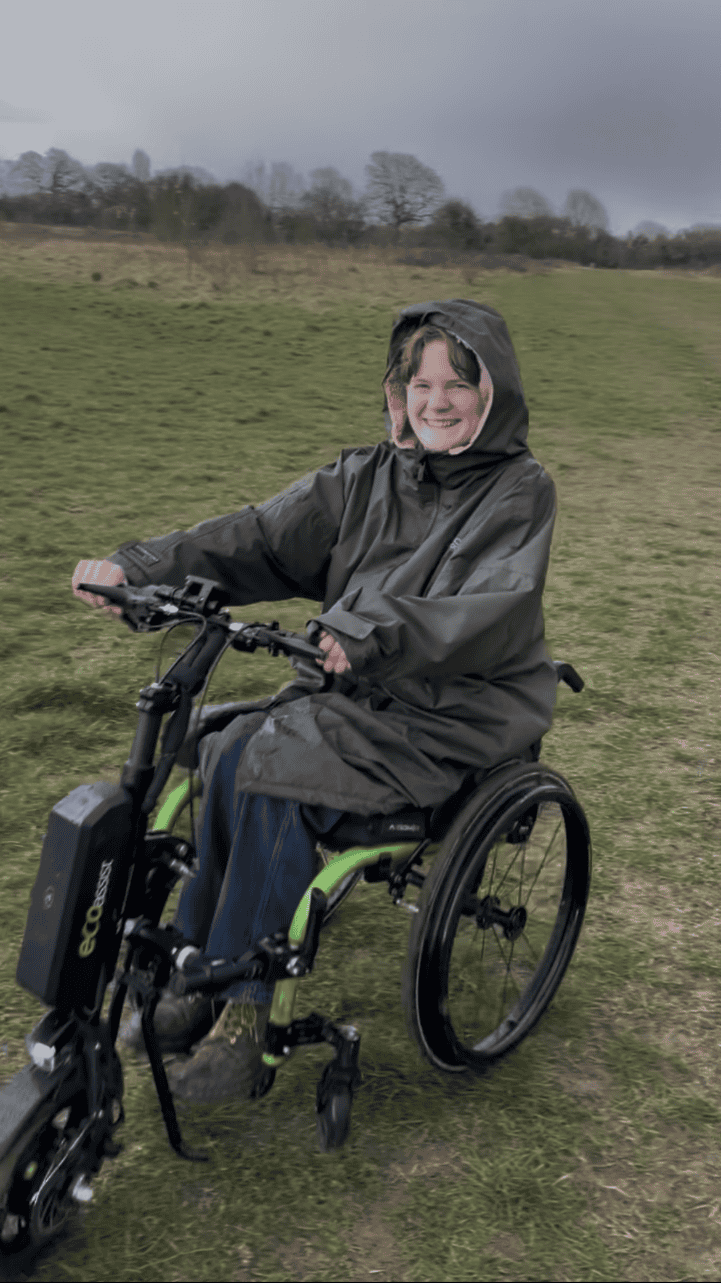
Starting a degree – in inaccessible accommodation:
Letty is studying for a master’s degree at a Russell Group university. This September, she moved into purpose-built university accommodation that was only completed a few years ago.
Letty loves going out in nature, especially around the local park, bird watching, and playing tennis.
“I planned my independence at university around using a front power assist: I have a Rehasense Eco Assist which I got about a year ago, which allows me to travel longer distances than I can self-propel. Power assists are such a gamechanger for many wheelchair users – not having to choose between the advantages of a manual chair and a powerchair, getting the best of both.”
“I was relieved when I heard there was storage for mobility aids and mobility scooters in the building. I thought, that will make things easier – I’ll be able to keep all my mobility aids there. I thought there would be lots of space and it would be an indoor accessible room.
“But then I moved in, and visited the storage room – it’s basically an outdoor shed. It has a really heavy door and it’s really narrow so I couldn’t get into it independently. Inside the shed it has a gravel channel that leaves gravel on the floor and there are charging cables all over the place so I wouldn’t be able to get around inside either. It was also not heated which is crucial for safe battery charging. It was supposedly designed for mobility scooters but I have no idea how someone using a full sized mobility scooter would get it in or out.
“In the first few weeks, I was dealing with other accessibility issues, so although I kept raising the store as a problem with the accommodation office, there was a limit to how frequently I could follow this up. Being Disabled, you’re always trying to work out which access issue is the priority, and what you have the capacity to handle!”
It’s not accessible if you have to ask permission to go out:
“To get my power assist out of the store during working hours, I had to go to the accommodation office. They were really busy – I’d have to wait in a queue for up to 20 minutes each time, just to get someone who could go to the storage room and retrieve my power assist.
“When staff were too busy, they couldn’t keep the accommodation office staffed, so they’d just close it and there wouldn’t be anyone who could help me.
“Outside office hours, I’d have to phone for security – and wait for however long it took until someone could get to me. It was rarely ever the same person twice, so just to pop to the shops I’d have to explain how the storage room worked and have unnecessary lengthy conversations.
“It really changed what I did and how I behaved. I missed out on doing loads of journeys I would have usually done because this process became an energy barrier. It was horrible – I had just moved to a new university and my independence was being restricted.”
Removing mobility removes independence – and causes injuries:
“Having to self-propel so much more meant an old shoulder injury started getting worse.
“After a few weeks, I couldn’t open doors that had been fine before because of how much the injury was bothering me. I’d have to wait for people to come along to let me through doors.
“It took me back to when I was first in a wheelchair and so much less independent – and there was no reason for me to have less independence, it was just a choice from the university.”
Unreasonable charging restrictions damaged Letty’s battery:
“Then the weather got colder, and I noticed my battery wasn’t lasting for journeys any more. On trips that used to be fine, like going to tennis each week, the battery couldn’t cope. Once I had to self-propel part way back to my accommodation, pushing the dead power assist in front of me. After that, I asked to take my charger with me when I went out – and I got handed a similar charger to mine, but with someone else’s name on it: it seemed my battery was being charged with the wrong charger, which is a fire risk and could have damaged the battery!
“The damaged battery is still really restricting what I can do because I can’t rely on it anymore – the amount remaining falls fast and unpredictably when I’m out. Replacing the battery costs about £500, which after much discussion the university has agreed to cover. But they were cynical that the charging environment could be the cause – they said things like ‘maybe you’re doing longer trips than you used to’ and argued that the storage room was not too cold. They had confused the temperature ranges for use in the manual with the temperature ranges for charging – they didn’t understand that minimum charging temperatures are different to minimum usage temperatures.
Dealing with hostile people in positions of authority can be the worst part of inaccessibility and discrimination:
“I kept making suggestions for how I could charge the battery safely and without damaging it. I explained my rights under the Equality Act and made it clear that the environment they were creating was discriminatory.
“I was desperately trying to come up with a viable solution – I asked to charge my battery in the accommodation office, whilst staff were working. I asked to charge it in the non-accommodation floors of the building. I asked if I could charge it in my room, but only when watching it – or if I could get a fireproof battery box and keep that in my room – they said no to everything and ignored the need for an alternative charging location.
“The process was so hostile – they kept claiming that charging in my room wasn’t possible, but they never suggested any other solutions. I felt like the onus was entirely on me to find the solution – they weren’t going to do any of their own research.
“I did ask them what they’d do if I was a powerchair user, and would they expect me to leave my powerchair in storage and walk to my room? And if so what about the fire risk of being left without a mobility aid if I needed to evacuate?”
And when the accommodation providers talked to fire experts – it turned out it had been fine for Letty to charge the battery in her room all along!
“Then when they eventually talked to the fire experts, they just came back and said I could charge it in my room. Just that. There wasn’t some big risk. I almost felt worse, because I was expecting to have to do one of the things I’d suggested – even though I didn’t think they were reasonable. I had spent so long needlessly looking for safe solutions when there was no actual fire risk in the first place. As soon as they talked to someone with knowledge on these batteries, I was fine to charge my power assist in my room.
“Everything that had happened, was just totally unnecessary.”
People can believe they’re providing reasonable adjustments when actually they’re creating and perpetuating inaccessible, harmful, discriminatory systems:
“I still don’t think the university understand what the problem was with the storage shed. They don’t understand that having to find someone, ask permission, and queue to get your mobility aid is an unreasonable barrier to doing basic activities of a type non-disabled people are simply not expected to tolerate.
“Being restricted in mobility and independence without an unavoidable reason, as I have been, is discrimination.
“Being the sole person trying to find an alternative whilst having my solutions constantly rejected was isolating, demoralizing and disempowering. It felt like the university were trying to evade responsibility and not trying to understand that just because I can theoretically manage to do something occasionally, doesn’t make it appropriate to force me to do that thing at all, let alone every time I want to go out.
“The inaccessibility I faced in my accommodation contributed to the discrimination I face daily, which disables and exhausts me. The extra physical and mental work I’ve been forced to do every time I wanted to leave my flat, and the extra stress, labour and admin I’m forced to take on to try and remove access barriers simply so I can participate in my course and my life, as I have the right to do, results in burnout and exclusion.”
We can do better: What service providers need to know
Different Disabled people use a wide range of different aids in different ways. What works for one person won’t work for another.
We need service providers to provide basic accessibility without question. That means meeting building regulations requirements, BS8300 guidance, and where applicable, Inclusive Mobility and LTN 1/20 Cycle Infrastructure Design guidance too.
We need service providers to listen: when the basic accessibility provided isn’t good enough, whether that’s infrastructure or policies and procedures causing the issues, we need changes to be made as far as possible to enable us to use your services independently, in the ways that work for us.
And that means making spaces as accessible as possible, not just barely possible to use.